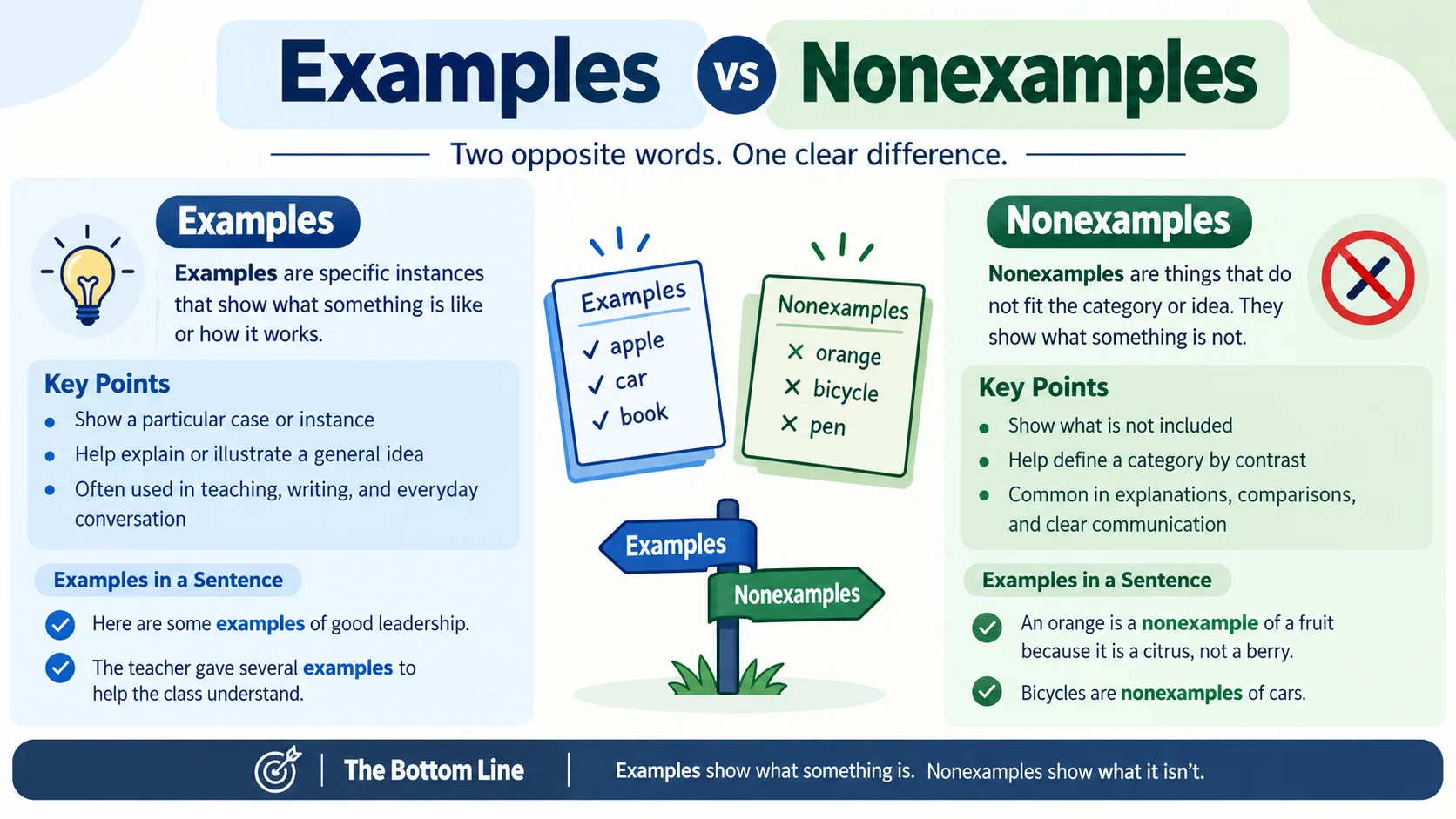
There is no single standard direct antonym for examples. In teaching and explanatory contexts, nonexamples can serve as the clearest contextual opposite because they show what does not fit a category or idea. Counterexamples are different: they are examples that challenge or disprove a general claim.
Direct and Strong Antonyms
Because examples does not have a conventional dictionary antonym that works across all meanings, it is important not to force related words into the category of direct antonyms.
| Word | Tone or Nuance | Example Sentence |
|---|---|---|
| Nonexamples | Contextual opposite; identifies what does not fit a category or idea | “The teacher used nonexamples to help students recognize the difference.” |
| Counterexamples | A contrasting type of example that challenges a general claim | “The researcher found a counterexample to the proposed rule.” |
Nonexamples is the stronger contextual opposite when the goal is classification. If something is an example of a category, a nonexample is something that does not belong to that category.
Counterexample, however, has a more specialized meaning. It is not the opposite of an example. It is still an example, but one that demonstrates that a general statement, rule, or claim is not universally true.
Contextual and Subtle Opposites
The best contrasting term for examples depends on what the speaker is trying to communicate.
| Context | Best Opposite or Contrast | Why It Fits |
|---|---|---|
| Teaching a category | Nonexamples | Shows what does not belong |
| Explaining a general rule | Counterexamples | Shows a case that challenges the rule |
| Discussing a claim | Exceptions | Identifies cases that do not follow the expected pattern |
| Describing a concept | Contrasts | Highlights differences rather than illustrating the concept |
These terms should not all be treated as direct antonyms.
Nonexamples is useful when defining boundaries. Suppose a teacher explains that a triangle has three sides. A square can function as a nonexample because it does not meet the defining condition.
Counterexamples are more specific. Consider the statement, “All birds can fly.” A flightless bird can serve as a counterexample because it challenges the universal claim.
Exceptions are also related but different. An exception is a person, situation, or case that does not follow an established rule or expectation. It can contrast with an example, but it is not inherently its opposite.
Words That Seem Opposite But Are Not
Counterexample
A counterexample is not an antonym of example. Grammatically and semantically, a counterexample is still an example. The prefix counter- indicates that it works against a particular claim, rule, or generalization.
For instance:
“The scientist provided a counterexample to the theory.”
The counterexample is still a specific instance. Its role is different because it challenges the conclusion being discussed.
Exception
An exception is another commonly confused contrast. An exception is something excluded from a rule, pattern, or general statement.
For example:
“Most employees work remotely on Fridays, with a few exceptions.”
The exceptions are cases that do not follow the usual pattern. They are not necessarily examples in the opposite sense.
Subtle Tone Differences
Choosing among nonexample, counterexample, exception, and contrast depends heavily on precision.
Nonexample is especially useful in education. It helps readers understand the boundaries of a concept by showing what does not qualify.
“The instructor gave three examples and two nonexamples of renewable energy sources.”
Counterexample is more analytical. It is appropriate when a specific case challenges a claim or proposed rule.
“One counterexample was enough to show that the statement was too broad.”
Exception focuses on a departure from an established pattern.
“The policy applies to all full-time employees, with limited exceptions.”
Contrast is broader and less technical. It simply highlights a difference between two things.
“The article uses contrast to show how the two approaches differ.”
These distinctions matter because replacing one term with another can change the intended meaning.
Frequently Asked Questions
What is the direct antonym of examples?
There is no single universally established direct antonym for examples. In educational or classification contexts, nonexamples is the clearest contextual opposite because it refers to things that do not fit a category or concept. It is better described as a contextual opposite than a universal lexical antonym.
Is nonexample the opposite of example?
Nonexample can function as the opposite of example when discussing categories, concepts, or definitions. An example demonstrates what belongs, while a nonexample demonstrates what does not belong. However, the relationship is contextual rather than a universal antonymic pair in every use.
What is the difference between an example and a counterexample?
An example illustrates a concept, rule, or idea. A counterexample is a particular example that challenges a general statement or rule. Therefore, a counterexample is not the opposite of an example. It is a specialized kind of example used for analytical purposes.
Conclusion
Examples does not have one perfect direct antonym in standard American English. When the goal is to identify what does not fit a category, nonexamples provides the clearest contextual contrast.
The distinction becomes especially important with words such as counterexample and exception. They express different relationships and should not automatically be labeled antonyms.
When you need an opposite-style term for examples, first determine what kind of contrast you mean. What word would you use in your own sentence?
