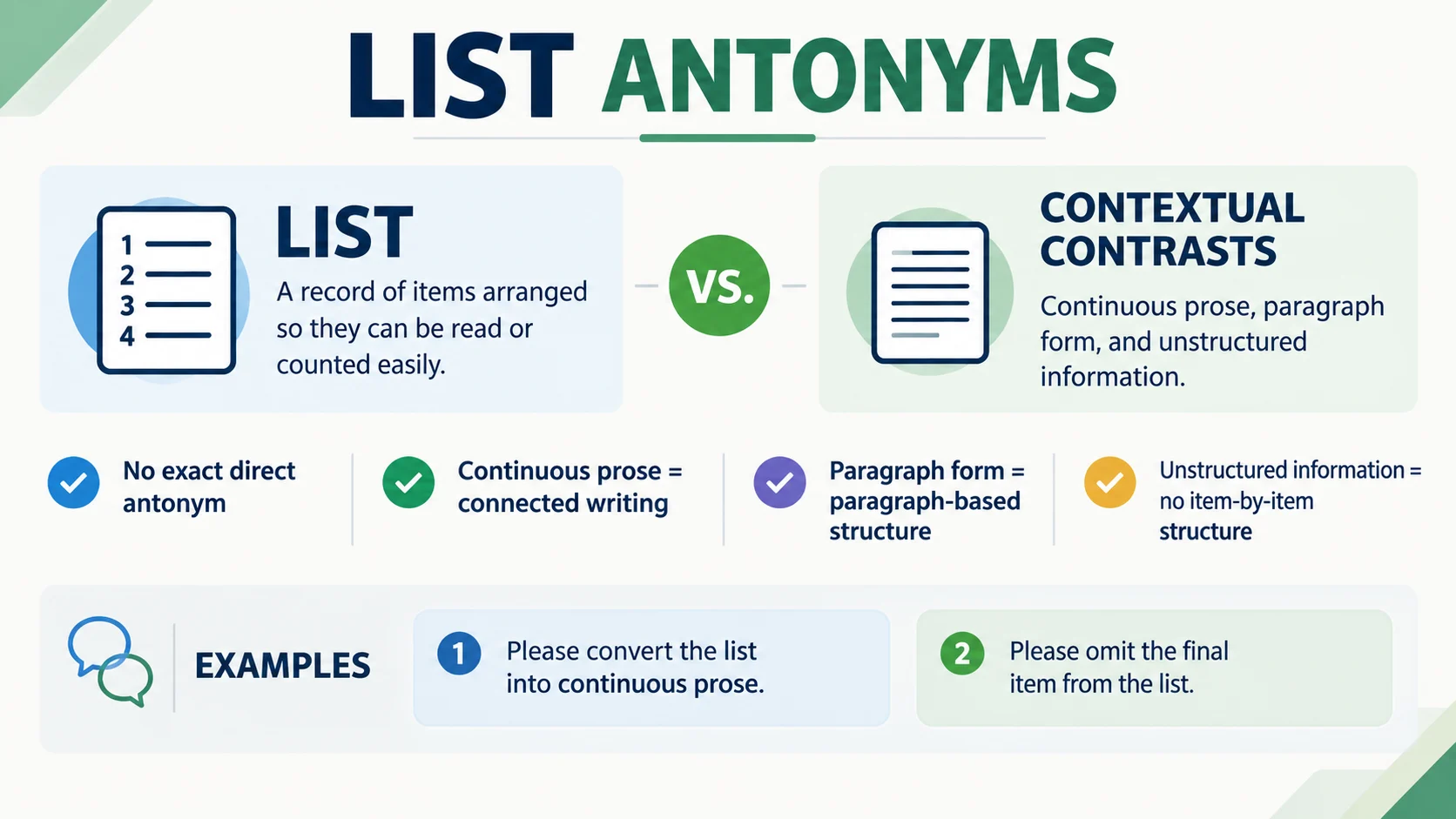
When list means a record of items arranged for easy reading, counting, or reference, English does not have one established word that functions as its exact semantic opposite. A list organizes information into separate entries. Depending on the context, continuous prose, paragraph form, or unstructured information can contrast with a list, but these are contextual opposites rather than true lexical antonyms.
Direct and Strong Antonyms
| Context | Best Opposite / Contrast | Why It Fits | Example |
|---|---|---|---|
| List as a record of items | No exact antonym | English has no single standard direct antonym for this sense of list. | “There is no direct antonym for list in this meaning.” |
| Writing format | Continuous prose | Prose presents connected ideas in sentences rather than separate list entries. | “The writer changed the list into continuous prose.” |
| Document structure | Paragraph form | Paragraphs organize information as connected text instead of separate entries. | “The editor changed the bullet list to paragraph form.” |
| Organization | Unstructured information | This contrasts with the clear item-by-item structure of a list. | “The notes contained unstructured information.” |
| List as a verb, meaning include | Omit | Omit means to leave something out, creating a contextual contrast with including it. | “She listed the required documents but omitted the optional form.” |
| List as a verb, meaning include | Exclude | Exclude emphasizes deliberately leaving something outside a group or record. | “The report listed all departments but excluded temporary staff.” |
| List meaning lean or tilt | Upright | An upright position can contrast with something that is leaning or listing. | “The boat began to list before returning to an upright position.” |
| List meaning lean or tilt | Level | Level can describe something that is no longer tilted to one side. | “The platform was listing, so the crew worked to make it level.” |
For the common meaning of list as a record of items, there is no standard direct antonym.
This distinction is important because words such as paragraph, prose, and disorder may seem opposite to list, but they do not have an exact semantic relationship with it.
A list is a particular way of organizing information. Its opposite is therefore usually expressed by describing a different organizational format rather than by using one opposite word.
For example:
“The instructions were presented as a list.”
A natural contrast would be:
“The instructions were presented in continuous prose.”
Here, continuous prose describes the alternative format, but it is not the dictionary antonym of list.
Contextual and Subtle Opposites
The best contextual opposite depends on what you mean by list and what feature you want to contrast.
1. List vs. Continuous Prose
Contextual opposite: continuous prose
A list separates information into distinct entries. Continuous prose presents information through connected sentences and paragraphs.
Example:
“Instead of giving the recommendations as a list, the writer explained them in continuous prose.”
This is useful when discussing articles, essays, reports, or other forms of writing.
2. List vs. Paragraph Form
Contextual opposite: paragraph form
Paragraph form is another practical contrast when information that could have been separated into individual entries is instead written as connected text.
Example:
“The editor changed the bullet list into paragraph form to make the section read more smoothly.”
The words paragraph form and list describe different structures rather than opposite dictionary meanings.
3. List vs. Unstructured Information
Contextual opposite: unstructured information
A list gives individual items a recognizable structure. Information that lacks a clear item-by-item arrangement can be described as unstructured.
Example:
“The meeting notes contained useful information, but the ideas appeared as unstructured information rather than a clear list.”
This contrast focuses on organization rather than vocabulary.
4. List as a Verb: Include vs. Omit
When list is used as a verb meaning “to record” or “to include in a list,” the context may call for a contrasting verb such as omit, exclude, or leave out.
These are not universal antonyms of list, but they can express the opposite action in a particular sentence.
Example:
“She listed every required document.”
“She omitted the optional document.”
The contrast here concerns whether an item is included, not whether something is technically the antonym of list.
5. List Meaning “Lean to One Side”
The word list has another important meaning as a verb: to lean or tilt to one side. This meaning is especially common when describing a ship or boat.
For this sense, words such as upright, level, or balanced may provide contextual opposites, depending on the sentence.
Example:
“The boat began to list to starboard.”
“The boat returned to an upright position.”
In this meaning, upright provides a useful contextual contrast, but the exact choice depends on what is being described.
Words That Seem Opposite But Are Not
Paragraph
Paragraph is not the direct antonym of list. A paragraph is a unit of prose, while a list is an arrangement of separate entries.
They can contrast when discussing document structure:
“Put the requirements in a list.”
“Put the requirements in a paragraph.”
The second sentence describes a different format, not the opposite meaning of list.
Disorder
Disorder can also seem like an opposite because lists often help organize information. However, a list can be disorganized, and information can be highly organized without being presented as a list.
For example, a carefully structured essay may be very orderly even though it contains no list.
Therefore, disorder is not an exact antonym of list.
Subtle Tone Differences
Different contextual alternatives emphasize different ideas.
Continuous prose is neutral and works well when discussing writing style or format.
Paragraph form is more specific when the alternative to a list is a paragraph-based structure.
Unstructured information emphasizes a lack of organization rather than simply the absence of a list.
Omit, exclude, and leave out are appropriate when the intended contrast concerns whether an item is included.
Compare these examples:
“Please convert the list into continuous prose.”
This focuses on presentation format.
“Please omit the final item from the list.”
This focuses on exclusion.
“The notes contain unstructured information.”
This focuses on organization.
Choosing the right expression makes the intended contrast much clearer.
Frequently Asked Questions
What is the direct antonym of list?
There is no single standard direct antonym for list when it means a record of items. Paragraph, continuous prose, and unstructured information can function as contextual contrasts, but they are not exact lexical antonyms.
What is the opposite of list in a writing context?
In a writing context, continuous prose or paragraph form can contrast with a list. A list separates information into individual entries, while prose connects ideas through sentences and paragraphs. The appropriate choice depends on the format being discussed.
What should I use instead of list in a sentence?
Choose the alternative according to your intended meaning. Use continuous prose when you mean connected writing, paragraph form when discussing document structure, and omit, exclude, or leave out when you mean not including an item.
Conclusion
The key point is that list has no single standard direct antonym in its common meaning of a record of items. Contextual alternatives such as continuous prose, paragraph form, and unstructured information describe different ways information can be presented, but they should not be presented as exact lexical opposites.
The meaning of list also matters. Its record-making sense and its “lean to one side” sense require different kinds of contrast. Precise word choice starts with identifying the intended meaning and then selecting language that expresses the exact difference.
What kind of sentence are you trying to write with list, and what opposite meaning do you want to express?
