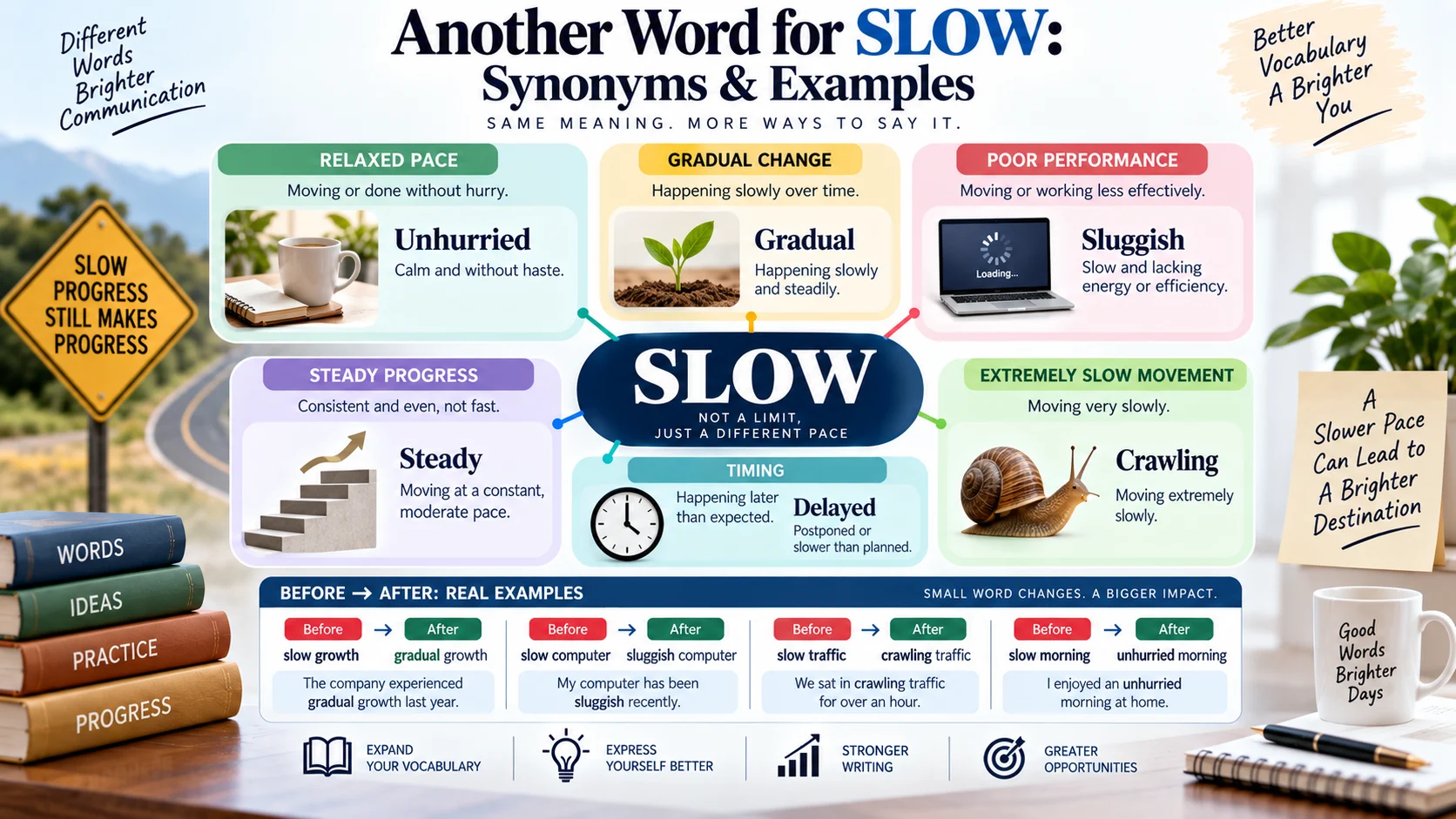
Another word for slow depends on the context. Common alternatives include unhurried, leisurely, gradual, sluggish, delayed, steady, leisurely, and sluggish. For formal writing, gradual or delayed may work better; for relaxed movement, unhurried or leisurely is often more precise.
What Does Slow Mean?
Definition
Slow generally describes something that moves, happens, develops, or operates without much speed. It can describe a person, physical movement, process, activity, business, technology, or rate of progress.
For example:
- The car is slow.
- She is a slow reader.
- The recovery was slow.
- Business was slow this month.
Cambridge also identifies several distinct uses of slow, including low physical speed, gradual progress, reduced business activity, and a person’s slower ability to understand or learn.
Common Uses
The best synonym changes according to what “slow” means in the sentence.
Slow movement:
Use unhurried, leisurely, sluggish, crawling, or creeping.
Slow progress or change:
Use gradual, steady, prolonged, or delayed.
Slow business activity:
Use quiet, inactive, sluggish, or slack.
Slow response:
Use delayed, hesitant, or reluctant, depending on the intended meaning.
Slow technology or performance:
Use sluggish, lagging, poky, or unresponsive.
This distinction matters because a synonym should preserve the original meaning rather than merely sound similar.
Best Synonyms for Slow
| Synonym | Meaning | Best Used When | Example |
|---|---|---|---|
| Unhurried | Happening without rushing | Relaxed actions or pace | She took an unhurried walk home. |
| Leisurely | Relaxed and without haste | Activities, travel, lifestyle | We enjoyed a leisurely breakfast. |
| Gradual | Happening little by little | Change, improvement, development | The company saw gradual growth. |
| Sluggish | Slow and lacking energy | People, systems, markets, movement | Sales remained sluggish. |
| Steady | Regular and consistent rather than fast | Progress, movement, performance | The team made steady progress. |
| Delayed | Happening later than expected | Responses, deliveries, events | The shipment was delayed. |
| Crawling | Extremely slow | Traffic, processes, movement | Traffic was crawling through downtown. |
| Decelerating | Becoming slower | Technical, scientific, or formal contexts | The vehicle was decelerating rapidly. |
Cambridge’s thesaurus distinguishes terms such as leisurely, unhurried, gentle, steady, gradual, and progressive, showing why context is more useful than treating every synonym as an exact replacement.
Synonyms by Context
Formal Writing
For formal and academic writing, choose words that describe why something is slow.
Gradual is useful for a change that develops over time:
The study observed a gradual improvement in performance.
Prolonged emphasizes that something continues for a long period:
The patient experienced a prolonged recovery period.
Delayed is appropriate when something occurs later than expected:
The project experienced a delayed launch.
Decelerating works well when describing a measurable reduction in speed or rate:
Economic growth is decelerating.
These words are usually more precise in professional or academic writing than simply repeating “slow.”
Professional Writing
In business communication, “slow” can have several meanings.
Instead of:
Sales were slow this quarter.
You could write:
Sales growth was sluggish this quarter.
Or:
Revenue growth was gradual this quarter.
If the issue is timing:
The approval process was delayed.
If the issue is productivity:
The workflow became less efficient.
If the issue is technology:
The application became sluggish during peak usage.
Cambridge’s Business English definition specifically uses “slow” for situations involving slow growth, recovery, progress, and periods when business activity is low.
Academic Writing
Academic writing benefits from precise alternatives.
Use gradual for change:
The experiment produced a gradual increase in temperature.
Use prolonged for duration:
Participants experienced a prolonged response time.
Use delayed when timing is the central issue:
The treatment resulted in a delayed response.
Use decelerated or decelerating when a rate is becoming slower:
The rate of growth decelerated during the final quarter.
Avoid replacing “slow” with a more complicated word simply to sound academic. The best choice is the word that expresses the exact relationship.
Daily Conversation
In everyday American English, simple alternatives usually sound most natural.
- Unhurried: We had an unhurried morning.
- Leisurely: We took a leisurely drive.
- Sluggish: I feel sluggish today.
- Crawling: Traffic is crawling.
- Taking forever: This download is taking forever.
Cambridge identifies poky as an informal U.S. English word for something slow, especially a car or computer system that performs poorly.
Professional Alternatives for Slow
If you are writing a resume, email, report, proposal, or business document, avoid using “slow” when a more specific word communicates the problem better.
Instead of “slow progress”
Use:
- gradual progress
- steady progress
- measured progress
- incremental progress
Resume example:
Instead of “Worked through slow improvements,” write “Supported steady, incremental improvements in team performance.”
Instead of “slow response”
Use:
- delayed response
- lengthy response time
- extended response time
Instead of “slow process”
Use:
- lengthy process
- time-consuming process
- extended process
- prolonged procedure
The goal is not to make your writing more complicated. It is to replace a vague description with a more accurate one.
Simple Alternatives for Slow
If you want easy words that most readers immediately understand, consider:
- late
- gradual
- unhurried
- steady
- delayed
- sluggish
- lengthy
- leisurely
For example:
Slow: The delivery was slow.
Simple: The delivery was delayed.
Slow: She walked slowly.
Simple: She walked at an unhurried pace.
Stronger Alternatives for Slow
Some words communicate a stronger or more specific degree of slowness.
Sluggish suggests low energy or poor responsiveness.
The computer became sluggish.
Crawling suggests extremely slow movement.
Traffic was crawling.
Prolonged emphasizes that something lasts longer than expected.
The negotiations entered a prolonged phase.
Tardy emphasizes lateness and is more formal or less common in everyday American English.
Dilatory means causing delay or intentionally taking longer than necessary and is considerably more formal.
Thesaurus.com lists a broad range of related terms, including sluggish, leisurely, gradual, crawling, deliberate, lagging, plodding, and dilatory, but these words carry different tones and meanings.
Difference Between Similar Synonyms
Slow vs. Gradual
Slow focuses on a low rate of speed or activity.
Gradual focuses on change occurring step by step.
The recovery was slow.
The recovery was gradual.
Both may work, but “gradual” is usually better when describing a process of change.
Slow vs. Sluggish
Slow is neutral.
Sluggish often suggests a lack of energy, efficiency, or responsiveness.
The train was slow.
The computer was sluggish.
Calling a computer “sluggish” suggests that its performance is unsatisfactory.
Slow vs. Leisurely
Slow does not necessarily imply comfort or relaxation.
Leisurely usually suggests that someone is intentionally taking their time.
The service was slow.
We enjoyed a leisurely lunch.
The first may be a complaint; the second is normally positive.
Slow vs. Delayed
Slow describes the rate.
Delayed describes timing relative to what was expected.
The internet connection is slow.
The payment was delayed.
Slow vs. Unhurried
Unhurried has a positive or neutral tone and suggests a relaxed pace.
She enjoyed an unhurried morning.
It is usually a better choice than “slow” when you want to communicate calmness rather than inefficiency.
Real-World Examples
Business Example
Original:
The company experienced slow growth during the first quarter.
Better:
The company experienced gradual growth during the first quarter.
If the growth was disappointing, sluggish growth may be more appropriate.
Academic Example
Original:
The participants showed slow improvement.
Better:
The participants showed gradual improvement over the study period.
Daily Conversation Example
Original:
Traffic was slow this morning.
Alternative:
Traffic was crawling this morning.
“Crawling” makes the degree of slowness stronger and more vivid.
Opposite Words
The most common opposites of slow are:
- Fast
- Quick
- Swift
- Speedy
- Rapid
- Prompt
- Expedited
The correct opposite depends on the same contextual distinction. For example, the opposite of delayed is usually prompt, while the opposite of slow-moving is fast-moving. Cambridge identifies fast and quick as common opposites of slow.
FAQs
What is another word for slow?
Common alternatives include unhurried, leisurely, gradual, sluggish, steady, delayed, crawling, and prolonged. The best choice depends on whether you are describing movement, progress, timing, performance, or activity.
What is a formal synonym for slow?
Gradual, prolonged, delayed, measured, and decelerating can work in formal writing, depending on the sentence. “Gradual” is especially useful for describing slow change.
What is a professional alternative for slow?
In professional writing, consider gradual, delayed, sluggish, lengthy, measured, or incremental. Choose the word that identifies the specific problem rather than simply replacing “slow.”
What word can replace slow in a resume?
Use a precise phrase such as gradual progress, measured growth, extended timeline, delayed implementation, or incremental improvement. Avoid using “slow” when a more positive or specific description is available.
What is a positive word for slow?
Leisurely, unhurried, measured, and sometimes steady can give a more positive impression. “Leisurely” and “unhurried” are especially useful when slowness is intentional and relaxed.
What is a stronger word for slow?
Sluggish suggests poor energy or performance, while crawling suggests extremely slow movement. Prolonged emphasizes extended duration rather than low physical speed.
Conclusion
The best alternative to slow depends on what you actually mean. Choose unhurried or leisurely for a relaxed pace, gradual for slow change, sluggish for poor performance or low activity, delayed for timing problems, and crawling for extremely slow movement.
Instead of searching for one universal replacement, identify the specific type of slowness first. That small distinction makes writing more precise, natural, and effective.
