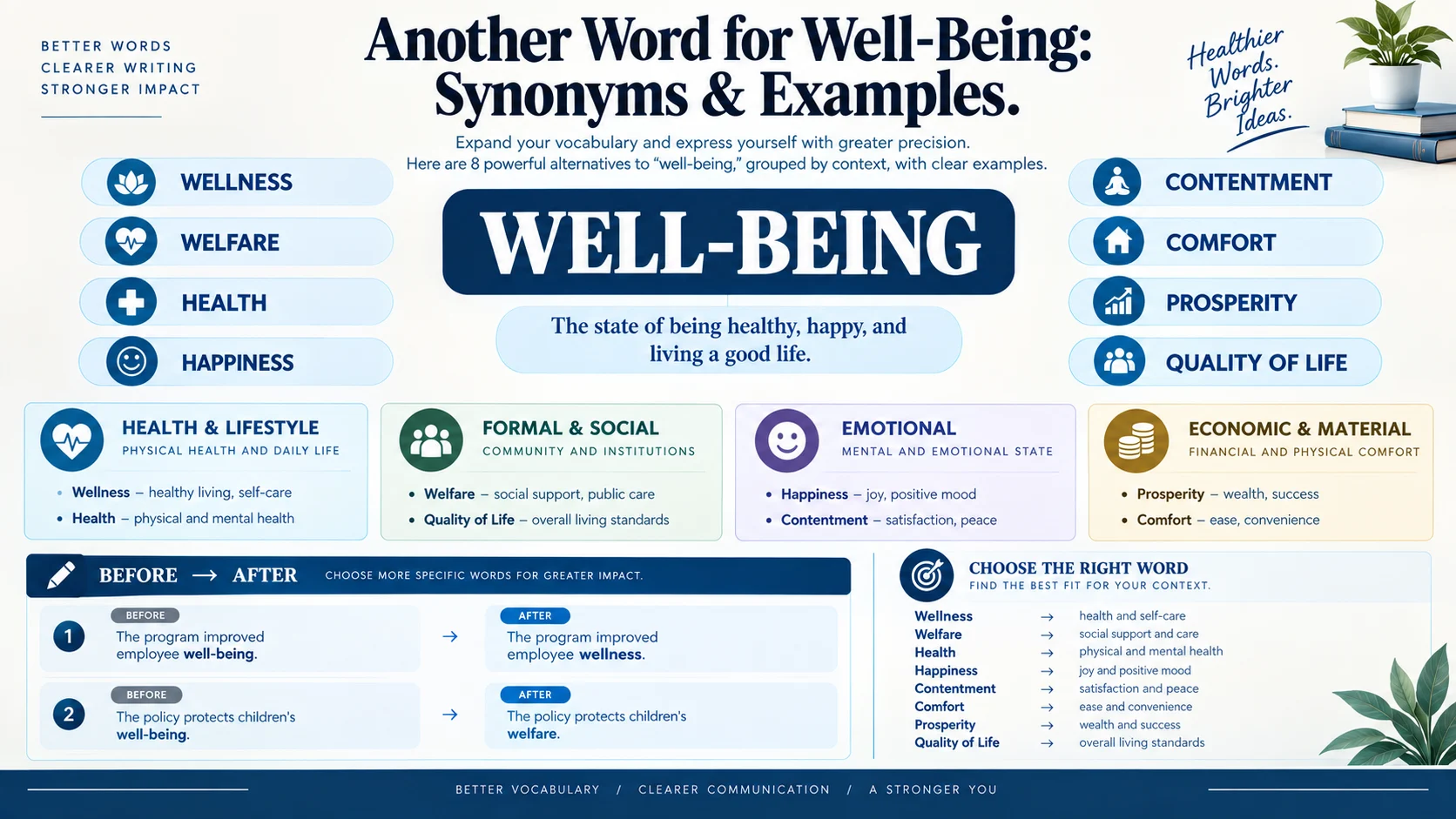
If you need another word for well-being, the best choices are wellness, welfare, health, happiness, comfort, prosperity, contentment, and quality of life. The right synonym depends on context. Wellness emphasizes healthy living, welfare often refers to someone’s overall interests or welfare, while health focuses more specifically on physical or mental condition.
What Does Well-Being Mean?
Definition
Well-being is the state of being healthy, happy, comfortable, and generally doing well. Cambridge Dictionary defines it as the state of feeling healthy and happy, while its thesaurus groups it with words such as welfare, happiness, health, wellness, and comfort.
Well-being can describe several dimensions of life, including:
- Physical well-being
- Mental well-being
- Emotional well-being
- Social well-being
- Financial well-being
- Overall quality of life
For example:
Regular exercise can improve your physical and mental well-being.
The word is especially common in discussions about health, education, workplaces, family life, psychology, economics, and social policy.
Common Uses
Well-being commonly appears in phrases such as:
- emotional well-being
- mental well-being
- physical well-being
- financial well-being
- employee well-being
- children’s well-being
- community well-being
- overall well-being
Because the word covers several dimensions of a person’s life, there is no single synonym that works perfectly in every situation.
Best Synonyms for Well-Being
| Synonym | Meaning | Best Used When | Example |
|---|---|---|---|
| Wellness | A state of good health, often maintained intentionally | Health, lifestyle, fitness | The program promotes employee wellness. |
| Welfare | Health, safety, interests, or general condition | Formal, social, government, professional contexts | The policy protects the welfare of children. |
| Health | Physical or mental condition | Medical and everyday contexts | Exercise supports good health. |
| Happiness | A positive emotional or mental state | Personal and emotional contexts | Strong relationships contribute to happiness. |
| Contentment | A feeling of satisfaction and peace | Personal writing and reflective contexts | She found contentment in a simpler lifestyle. |
| Comfort | Physical or emotional ease | Personal, caregiving, and practical contexts | The changes were made for the comfort of residents. |
| Prosperity | Financial or material success | Economic and business contexts | Economic prosperity can influence people’s quality of life. |
| Quality of life | Overall standard of health, comfort, and life satisfaction | Academic, medical, professional contexts | The treatment improved his quality of life. |
Thesaurus sources similarly associate well-being with comfort, contentment, happiness, health, prosperity, and welfare, although these words have different meanings and should not automatically be substituted for one another.
Synonyms by Context
Formal Writing
For formal writing, the strongest alternatives are:
- Welfare
- Wellness
- Quality of life
- Health
- General welfare
- Overall condition
Welfare is particularly useful when discussing the interests, safety, or general condition of people or groups.
Example:
The legislation was designed to protect the welfare of vulnerable populations.
By contrast:
The legislation was designed to improve the well-being of vulnerable populations.
Both sentences work, but welfare sounds more institutional and policy-oriented.
Professional Writing
In workplace and business communication, wellness, health, and employee welfare are useful alternatives.
Business example:
The company introduced a new employee wellness initiative.
Here, wellness works better than happiness because the program may involve physical health, mental health, stress management, and healthy habits.
Another example:
The organization is committed to the well-being of its employees.
A more formal version could be:
The organization is committed to employee welfare.
Academic Writing
Academic writing often benefits from precise alternatives such as:
- Quality of life
- Psychological health
- Mental health
- Physical health
- Life satisfaction
- Welfare
The best choice depends on exactly what is being measured.
Academic example:
Researchers examined the effect of social relationships on participants’ psychological well-being.
If the research specifically measures satisfaction with one’s circumstances, life satisfaction may be more precise.
If the research concerns physical and functional outcomes, health or quality of life may be preferable.
Daily Conversation
In everyday conversation, natural alternatives include:
- Health
- Happiness
- Comfort
- Feeling good
- Wellness
For example:
I’m trying to focus more on my well-being.
Could become:
I’m trying to focus more on my health.
Or:
I’m trying to focus more on my happiness.
The best replacement depends on what the speaker actually means.
Professional Alternatives for Well-Being
If you’re writing a resume, business report, company policy, email, or workplace document, consider these alternatives:
Wellness — best for employee health and lifestyle programs.
Developed initiatives designed to improve employee wellness.
Welfare — best for employee safety, interests, and general support.
Implemented policies focused on employee welfare.
Quality of life — best when discussing broad living conditions or long-term outcomes.
The project aims to improve residents’ quality of life.
Health — best when the focus is physical or mental condition.
Promoted workplace health through preventative programs.
Employee satisfaction — useful when the intended meaning concerns how employees feel about their workplace rather than their overall health.
The initiative improved employee satisfaction and retention.
Simple Alternatives for Well-Being
For simple, easy-to-understand writing, use:
- Health
- Happiness
- Comfort
- Wellness
- Feeling good
- Quality of life
For example:
Original:
Exercise can improve your overall well-being.
Simpler:
Exercise can improve your overall health.
Or:
Exercise can help you feel better.
The simplest replacement is not always the closest synonym. Health is easier, but it does not capture every aspect of well-being.
Stronger Alternatives for Well-Being
When you want a more precise or sophisticated expression, consider:
- Holistic wellness
- Quality of life
- Life satisfaction
- Psychological health
- Overall welfare
- Human flourishing
Human flourishing is particularly useful in philosophical, psychological, educational, and academic discussions where the idea extends beyond simply being healthy or happy.
For example:
Education can contribute to human flourishing by developing knowledge, relationships, purpose, and personal capabilities.
This is broader and more conceptually specific than simply saying:
Education can improve well-being.
Difference Between Similar Synonyms
Well-Being vs. Wellness
Well-being is broader. It can refer to overall physical, emotional, social, psychological, and financial condition.
Wellness tends to emphasize health and the active pursuit or maintenance of a healthy lifestyle. Cambridge defines wellness as a state of being healthy, particularly when it is something a person actively tries to achieve.
Well-Being vs. Welfare
Welfare often refers to someone’s health, safety, interests, or general condition. It is especially common in formal, institutional, governmental, and social contexts.
The school is concerned about the student’s well-being.
The government program protects the welfare of children.
Well-Being vs. Health
Health specifically concerns physical or mental condition.
Well-being is broader and can include health plus happiness, relationships, financial security, comfort, and life satisfaction.
Well-Being vs. Happiness
Happiness describes a positive emotional state.
Well-being is broader. A person can have good well-being without feeling happy every moment.
Well-Being vs. Prosperity
Prosperity generally emphasizes financial or material success.
Economic prosperity can support people’s well-being.
The two concepts overlap, but they are not synonyms in every context.
Well-Being vs. Quality of Life
Quality of life usually describes how good or satisfactory a person’s overall living circumstances are. It is particularly useful in medical, academic, social-science, and policy writing.
Opposite Words
Common opposites or contrasting terms for well-being include:
- Ill-being
- Poor health
- Illness
- Sickness
- Distress
- Hardship
- Discomfort
- Adversity
The exact opposite depends on context. For example, illness contrasts with health, while distress contrasts more directly with emotional well-being.
FAQs
What is another word for well-being?
The best general alternatives are wellness, welfare, health, happiness, comfort, contentment, prosperity, and quality of life. Wellness is often the closest choice when discussing healthy living, while welfare works well in formal or institutional contexts.
What is a formal synonym for well-being?
Welfare is one of the strongest formal alternatives, particularly when discussing people’s safety, interests, or general condition. Quality of life is also appropriate in academic, medical, and policy contexts.
What is a professional alternative for well-being?
Wellness, employee welfare, health, quality of life, and employee satisfaction can work in professional writing. Choose the term based on whether you’re discussing health, workplace conditions, living standards, or employee attitudes.
What word can replace well-being?
Use wellness for healthy living, health for physical or mental condition, happiness for emotional positivity, welfare for overall interests or protection, and quality of life for broader living conditions.
Is wellness the same as well-being?
Not exactly. The terms overlap, but well-being is broader. Wellness commonly emphasizes health and intentional efforts to maintain or improve it.
Is welfare a synonym for well-being?
Yes, in some contexts. Major thesaurus sources list welfare among words related to well-being. However, welfare can carry stronger associations with protection, social support, public policy, and someone’s general interests.
What is a synonym for emotional well-being?
Depending on the context, alternatives include emotional health, emotional wellness, happiness, contentment, and psychological well-being. The most accurate choice depends on what aspect of emotional well-being is being discussed.
What is a synonym for financial well-being?
Possible alternatives include financial health, financial security, financial stability, economic well-being, and financial prosperity. These are related but emphasize different aspects of a person’s financial situation.
Conclusion
The best synonym for well-being depends on what you want to emphasize. Wellness is ideal for healthy living and lifestyle programs. Welfare works particularly well in formal and institutional writing. Health is simpler and more specific, while happiness focuses on emotions. Quality of life is useful for academic, medical, and professional contexts, and prosperity fits economic discussions.
When replacing well-being, don’t choose a synonym simply because it appears in a thesaurus. Consider the exact meaning of your sentence first. The most effective word is the one that preserves your intended meaning while matching the tone and context.
