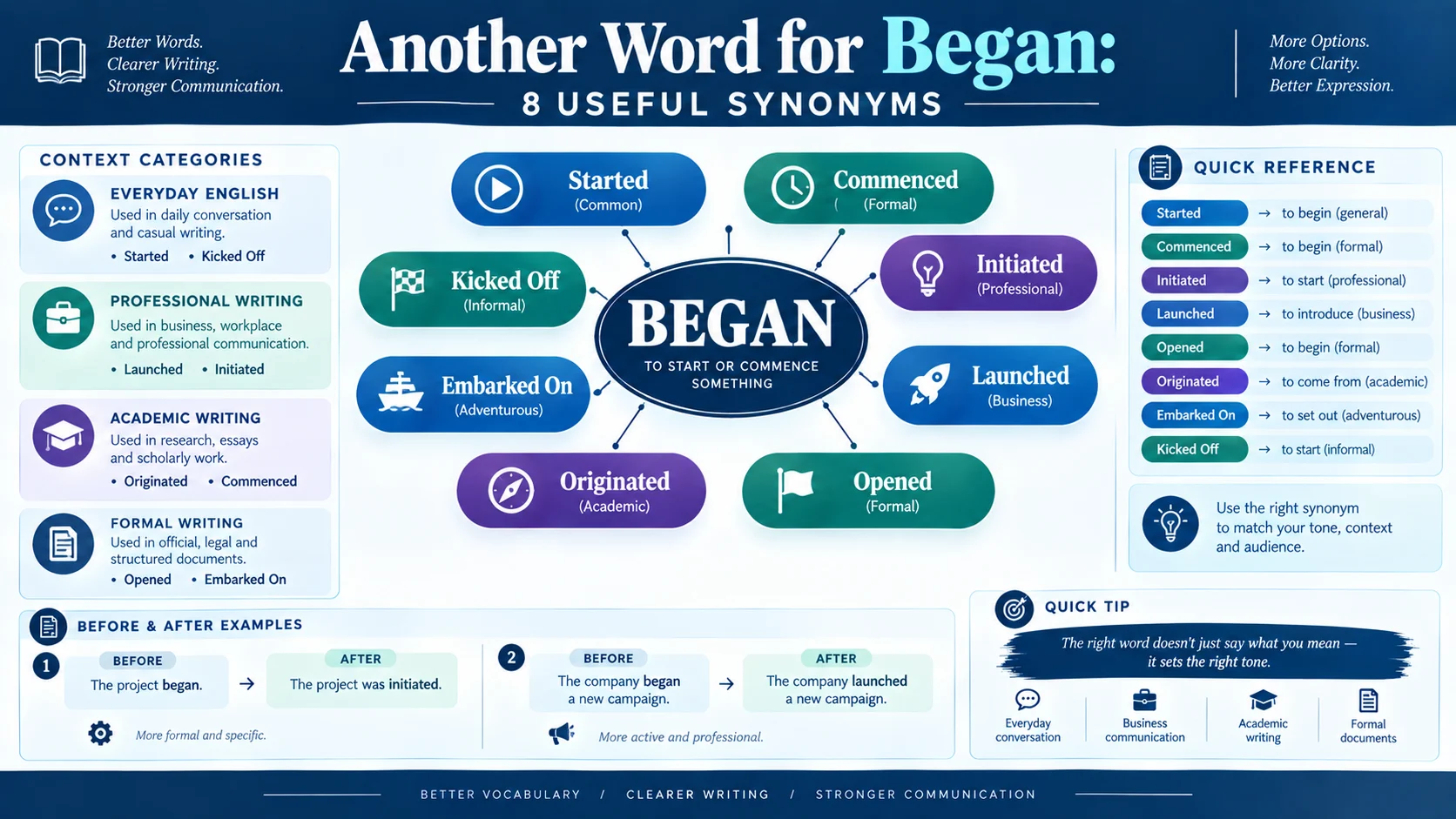
Another word for “began” is started, commenced, initiated, launched, opened, originated, or kicked off. The best synonym depends on context: started is the most common choice for everyday English, commenced works well in formal writing, initiated emphasizes the beginning of an action or process, and launched is often used for projects, products, or campaigns. These alternatives make writing clearer and more precise in academic, professional, formal, and everyday contexts.
What Does “Began” Mean?
Definition
Began is the past tense of begin, meaning that something started or came into existence at a particular time. It can describe an action, activity, event, process, conversation, period, or experience that started in the past.
For example:
The meeting began at 9 a.m.
Depending on the context, alternatives to began include started, commenced, initiated, launched, opened, originated, emerged, and kicked off.
Common Uses
The word began is common in everyday speech and writing. It can be used to describe:
- An event that started: “The concert began at 8 p.m.”
- An action that started: “She began writing the report.”
- A process that started: “The investigation began last month.”
- A period or situation that started: “The economic downturn began in 2020.”
- A career or journey that started: “He began his career in finance.”
The best synonym depends on the level of formality and the exact meaning you want to express.
Best Synonyms for “Began”
| Started | Began or set something in motion | Everyday and general writing | The class started at noon. |
| Commenced | Began formally | Business, legal, or formal writing | The project commenced in January. |
| Initiated | Caused or formally started something | Professional and technical contexts | The company initiated a review. |
| Launched | Started something publicly or officially | Products, campaigns, businesses, projects | The company launched a new service. |
| Opened | Began an event, meeting, discussion, or period | Meetings, ceremonies, debates | The chair opened the meeting. |
| Originated | First came into existence or began from a source | History, research, ideas, movements | The tradition originated in Europe. |
| Emergent | Beginning to develop or appear | Trends, conditions, ideas | An emergent trend began to influence the industry. |
| Kicked off | Started, often energetically or informally | Conversation, sports, campaigns, events | The tournament kicked off Saturday. |
Started
Meaning: To begin doing something or cause something to begin.
Best used for: Almost any general situation.
Tone: Neutral and natural.
Difficulty: Easy
Usage Frequency: Very Common
Best for: Resume writing, email writing, essays, marketing copy, and business writing.
Examples:
- Business: The company started expanding into new markets.
- Academic: The study started with a review of previous research.
- Daily conversation: The movie started around seven.
For most situations, started is the simplest and most natural replacement for began.
Commenced
Meaning: Began or officially started.
Best used for: Formal announcements, legal documents, business reports, and official writing.
Tone: Formal
Difficulty: Advanced
Usage Frequency: Less Common
Best for: Business writing, academic writing, legal writing, and formal reports.
Examples:
- Business: Construction commenced in early spring.
- Academic: The experiment commenced after all participants had arrived.
- Daily conversation: The ceremony commenced at six o’clock.
Commenced is grammatically correct but can sound unnecessarily formal in casual conversation. In most everyday contexts, started is better.
Initiated
Meaning: Started a process, action, procedure, or formal activity.
Best used for: Professional, technical, administrative, and academic contexts.
Tone: Formal and professional
Difficulty: Medium
Usage Frequency: Common
Best for: Resume writing, business writing, academic writing, and technical documents.
Examples:
- Business: The manager initiated a new employee training program.
- Academic: Researchers initiated the investigation after identifying the problem.
- Daily conversation: She initiated a conversation about the issue.
Initiated often suggests that someone deliberately caused something to start.
Launched
Meaning: Started or introduced something, usually publicly or officially.
Best used for: Products, services, businesses, campaigns, websites, initiatives, and projects.
Tone: Professional and energetic
Difficulty: Easy
Usage Frequency: Very Common
Best for: Marketing copy, business writing, resumes, and professional communication.
Examples:
- Business: The company launched a new software platform.
- Academic: The university launched a research initiative.
- Daily conversation: They launched the website last week.
Use launched when the idea of a public introduction or major rollout matters.
Opened
Meaning: Began an event, meeting, discussion, ceremony, or period.
Best used for: Meetings, conferences, speeches, ceremonies, negotiations, and discussions.
Tone: Neutral to formal
Difficulty: Easy
Usage Frequency: Very Common
Examples:
- Business: The CEO opened the annual meeting with a short speech.
- Academic: The professor opened the discussion by asking a question.
- Daily conversation: The host opened the show with a joke.
Opened is more specific than began. It generally refers to starting an organized event, discussion, or occasion.
Synonyms by Context
Formal Writing
For formal writing, the strongest alternatives to began are:
commenced, initiated, originated, launched, and opened.
Example:
The review process commenced following the submission of the application.
This sounds more formal than:
The review process began following the submission of the application.
However, avoid choosing a complicated synonym simply to sound sophisticated. Clear language is usually more effective than unnecessarily formal wording.
Professional Writing
In professional documents, started, initiated, launched, and commenced are useful depending on the situation.
For a resume, action-oriented language is often stronger:
Initiated a customer feedback program that improved communication between sales and support teams.
For a business announcement:
The company launched its new customer service platform in March.
For a formal report:
The audit commenced following management approval.
Academic Writing
Academic writing often benefits from precise alternatives such as initiated, commenced, originated, emerged, and started.
For example:
The research project began with an examination of existing literature.
Could become:
The research project commenced with an examination of existing literature.
When discussing the origin of an idea, movement, theory, or phenomenon, originated may be more precise:
The theory originated in the early twentieth century.
Daily Conversation
In everyday American English, started is usually the best alternative.
Natural:
The game started at eight.
Less natural in casual conversation:
The game commenced at eight.
Other conversational choices include kicked off and got started.
The party kicked off around nine.
These expressions are informal and should generally be avoided in formal academic or professional writing.
Professional Alternatives for “Began”
If you need a stronger word for a resume, report, business document, or professional email, consider:
- Initiated — emphasizes deliberate action.
- Launched — emphasizes an official beginning.
- Commenced — emphasizes a formal beginning.
- Established — emphasizes creating something that continues.
- Implemented — emphasizes putting a plan or system into action.
- Introduced — emphasizes bringing something new into use.
- Opened — works well for meetings, discussions, and events.
For example, instead of:
Began a new customer outreach program.
A stronger professional version could be:
Initiated a customer outreach program to strengthen client engagement.
The best replacement depends on what actually happened. Do not use launched or implemented if the original action did not involve an official launch or execution.
Simple Alternatives for “Began”
If you want an easy word that readers immediately understand, use:
started, got started, opened, or kicked off.
The most versatile choice is started.
Examples:
- The lesson began → The lesson started.
- She began working → She started working.
- The event began at noon → The event started at noon.
Stronger Alternatives for “Began”
Some alternatives add a more specific meaning rather than simply replacing began.
Initiated suggests intentional action.
Launched suggests a significant or public beginning.
Originated identifies where something first came from.
Established suggests that something was created and put into a lasting position.
Embarked on suggests beginning a journey, project, or significant undertaking.
For example:
The organization began a major expansion.
Could become:
The organization embarked on a major expansion.
This version emphasizes that the expansion is a substantial undertaking.
Difference Between Similar Synonyms
Began vs. Started
These words are usually interchangeable.
The meeting began at 10.
The meeting started at 10.
Started is generally more conversational, while began can sound slightly more polished in formal prose.
Began vs. Commenced
Both mean “started,” but commenced is considerably more formal.
Use commenced when the writing calls for an official or formal tone. Use began or started for ordinary communication.
Began vs. Initiated
Began simply describes a beginning. Initiated often implies that a person, organization, or system deliberately caused something to begin.
The discussion began at noon.
The manager initiated the discussion.
The second sentence identifies an active initiator.
Began vs. Launched
Launched is appropriate when something is introduced, released, or started publicly.
The company began a project.
The company launched a new product.
The second sentence has a more specific meaning because a product launch usually involves an official introduction.
Began vs. Originated
Originated focuses on the source or earliest point of something.
The movement began in the 1960s.
The movement originated in the 1960s.
Originated emphasizes where or when the movement first developed.
Opposite Words
Common opposites of began include:
- Ended
- Finished
- Concluded
- Stopped
- Completed
- Terminated
- Ceased
- Closed
The appropriate opposite depends on context.
For example, began and ended work naturally for an event:
The conference began at 9 a.m. and ended at 5 p.m.
For a project, began and completed may be more appropriate:
The team began the project in January and completed it in June.
FAQs
What is another word for began?
The most common synonym for began is started. Other alternatives include commenced, initiated, launched, opened, originated, and kicked off. The best choice depends on whether the context is casual, professional, academic, or formal.
What is a formal synonym for began?
Commenced is one of the most formal synonyms for began. Initiated is also appropriate when someone deliberately starts a process or action.
What is a professional alternative for began?
Initiated and launched are strong professional alternatives. Use initiated for processes, programs, or actions and launched for products, services, campaigns, and major initiatives.
What word can replace began in a sentence?
In most sentences, started can replace began. Depending on the meaning, you can also use commenced, initiated, launched, opened, originated, or embarked on.
What is another word for “began” in an essay?
For an essay, started, commenced, initiated, originated, or emerged may work depending on the sentence. Avoid replacing began with a more complicated word unless it adds a more precise meaning.
What is another word for began on a resume?
For a resume, consider initiated, launched, established, implemented, introduced, or led, depending on what you actually accomplished. These words can communicate action more clearly than simply saying “began.”
Is “started” the same as “began”?
Yes, in most situations. Started and began are interchangeable when they simply describe something coming into action or existence. Started is generally more conversational, while began can sound slightly more polished.
Conclusion
The best synonym for began depends on the context. Started is the safest and most natural choice for everyday English. Commenced works well in formal writing, initiated emphasizes deliberate action, launched suits products and initiatives, opened fits events and discussions, and originated is useful when discussing the source of an idea, movement, or phenomenon.
When choosing a replacement, focus on meaning rather than simply selecting the most sophisticated-sounding word. The right synonym should make the sentence more precise, natural, and appropriate for its audience.
