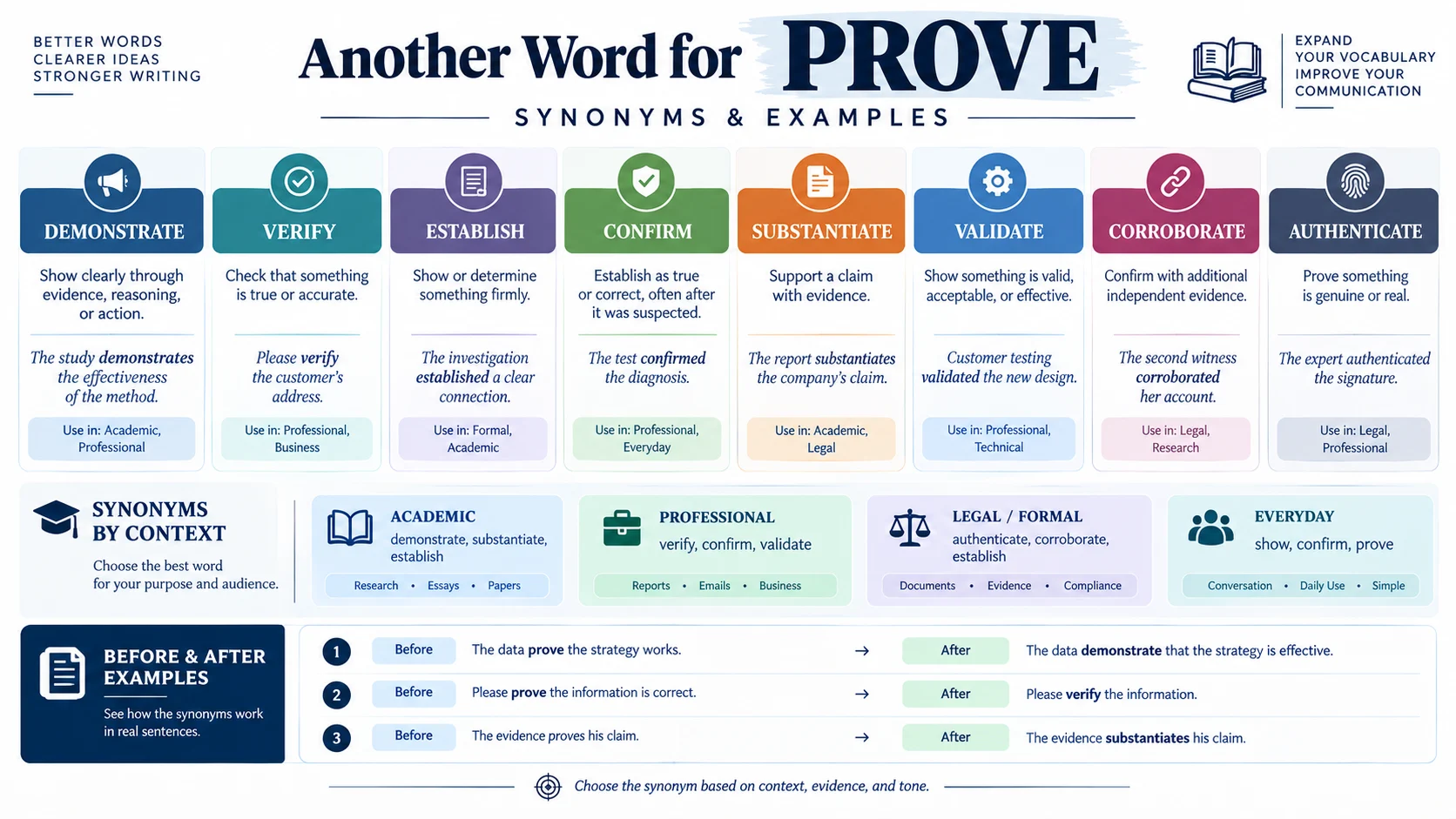
Another word for prove is demonstrate, especially when you want to show clearly that something is true or correct. Depending on context, alternatives include verify, establish, confirm, substantiate, validate, authenticate, corroborate, and show. The best synonym depends on whether you are presenting evidence, confirming a fact, or showing ability.
What Does Prove Mean?
Definition
Prove is a verb meaning to use facts, evidence, reasoning, experience, or results to show that something is true, correct, genuine, or effective. It can also mean showing that a person has a particular ability or quality.
For example:
- The evidence proved that the document was authentic.
- The experiment proved the hypothesis was incorrect.
- She worked hard to prove her ability.
- The new strategy proved effective.
Oxford also identifies another use of prove: something can “prove to be” a particular way when experience shows its actual quality or result, as in “The strategy proved successful.”
Common Uses
The word prove commonly appears when you need to:
- Establish that something is true
- Support a claim with evidence
- Confirm information
- Demonstrate an ability or quality
- Establish the validity of an argument
- Show that something works
- Establish that a person is responsible or innocent
- Show the result or quality of something over time
Because these meanings overlap but are not identical, choosing a more precise synonym can make your writing clearer.
Best Synonyms for Prove
| Synonym | Meaning | Best Used When | Example |
|---|---|---|---|
| Demonstrate | Show something clearly through evidence or action | Formal, academic, and professional writing | The study demonstrates the effectiveness of the method. |
| Verify | Check and establish that something is accurate or true | Facts, data, information, and records | Please verify the customer’s address. |
| Establish | Show or determine something firmly | Arguments, facts, relationships, and findings | The investigation established a clear connection. |
| Substantiate | Support a claim with evidence | Academic, legal, and professional writing | The report substantiates the company’s claim. |
| Confirm | Establish that something believed or suspected is true | Information, results, appointments, and details | The test confirmed the diagnosis. |
| Validate | Show that something is valid, acceptable, or effective | Research, processes, systems, and ideas | The results validate the proposed approach. |
| Corroborate | Confirm something using additional independent evidence | Research, investigations, and formal writing | The second witness corroborated her account. |
| Authenticate | Establish that something is genuine or real | Documents, identities, products, and records | The expert authenticated the signature. |
| Support | Provide evidence or reasons for a claim | Essays, reports, arguments, and presentations | The data support the researchers’ conclusion. |
| Certify | Officially confirm that something meets a standard | Credentials, products, compliance, and qualifications | The organization certified the product as safe. |
| Attest | Confirm or formally state that something is true | Legal and highly formal contexts | The records attest to his involvement. |
| Justify | Provide a valid reason or evidence for something | Decisions, actions, arguments, and conclusions | The evidence justified the decision. |
Cambridge’s thesaurus groups words such as verify, establish, substantiate, corroborate, authenticate, confirm, validate, demonstrate, and justify among terms related to the evidence-based sense of prove.
Synonyms by Context
Formal Writing
For formal writing, choose words that specify how something has been established.
Best options: demonstrate, establish, substantiate, verify, corroborate, authenticate, validate.
Example:
Instead of:
The results prove that the treatment works.
You could write:
The results demonstrate that the treatment is effective.
Demonstrate often sounds more precise in formal writing because it emphasizes showing something through evidence, reasoning, or observable results.
Professional Writing
In business and workplace communication, confirm, verify, establish, validate, and demonstrate are particularly useful.
Examples:
- Please verify the information before submitting the report.
- The audit confirmed that the records were accurate.
- The results demonstrate the value of the new process.
- Customer feedback validated our decision to update the service.
For professional writing, the right replacement often depends on the action being performed. Use verify when checking accuracy, confirm when establishing that something is true, and validate when determining whether something is acceptable or effective.
Academic Writing
Academic writing benefits from precise distinctions between evidence and conclusions.
Useful alternatives include:
demonstrate, establish, substantiate, support, confirm, corroborate, and validate.
For example:
The findings support the hypothesis.
is slightly different from:
The findings confirm the hypothesis.
Support suggests that evidence provides backing for an idea, while confirm indicates that the evidence establishes that something previously proposed or suspected is true.
Academic writing should therefore avoid replacing prove automatically. In many research contexts, support, suggest, or demonstrate may communicate the strength of the evidence more accurately.
Daily Conversation
For everyday English, simple alternatives are often more natural:
- show
- confirm
- demonstrate
- verify
- show that
Examples:
Can you prove it?
can become:
Can you show me?
Or:
The results proved he was right.
can become:
The results showed that he was right.
Show is especially useful when you want conversational, straightforward language.
Professional Alternatives for Prove
If you are writing an email, report, proposal, resume, or business document, consider these alternatives:
Demonstrate
Meaning: Show something clearly through evidence, results, or action.
Tone: Professional and confident
Difficulty: Medium
Usage: Very Common
Best for: Resume, email writing, academic writing, business writing, marketing copy.
Resume example:
Demonstrated strong project-management skills by completing five projects ahead of schedule.
Establish
Meaning: Show or determine something firmly.
Tone: Formal and authoritative
Difficulty: Medium
Usage: Common
Best for: Academic writing, reports, legal writing, business writing.
Example:
The analysis established a strong relationship between customer retention and service quality.
Substantiate
Meaning: Provide evidence that supports a claim.
Tone: Formal
Difficulty: Advanced
Usage: Common in specialized writing
Best for: Academic writing, legal writing, business reports.
Example:
The company provided financial records to substantiate its claim.
Verify
Meaning: Check whether information is accurate or true.
Tone: Professional and precise
Difficulty: Easy
Usage: Very Common
Best for: Email writing, business writing, technical writing.
Example:
Please verify the figures before publishing the report.
Validate
Meaning: Establish that something is valid, sound, acceptable, or effective.
Tone: Professional and technical
Difficulty: Medium
Usage: Common
Best for: Business writing, research, technology, marketing.
Example:
Customer testing validated the effectiveness of the new design.
Simple Alternatives for Prove
If you want easy-to-understand language, use:
- Show
- Confirm
- Check
- Demonstrate
- Support
- Establish
The simplest replacement is often show.
For example:
Original:
The evidence proves that the claim is false.
Simple:
The evidence shows that the claim is false.
Original:
Can you prove your identity?
Simple:
Can you show proof of your identity?
Notice that proof is the noun form, while prove is the verb. Cambridge defines proof as information or a fact that shows something exists or is true.
Stronger Alternatives for Prove
When you want to emphasize strong evidence, consider:
- Establish
- Substantiate
- Confirm
- Authenticate
- Corroborate
- Certify
- Demonstrate
However, these words are not interchangeable in every sentence.
For example:
- Authenticate a document means establish that it is genuine.
- Corroborate a statement means provide additional evidence that supports it.
- Certify something generally involves an official confirmation.
- Substantiate a claim means provide evidence supporting it.
- Verify information means check its accuracy.
- Demonstrate something means make it clear through evidence, reasoning, or action.
Choosing the more specific verb can make your sentence considerably more precise.
Difference Between Similar Synonyms
Prove vs. Demonstrate
Prove emphasizes establishing truth or correctness. Demonstrate emphasizes clearly showing something through evidence, reasoning, results, or action.
The experiment demonstrated the effectiveness of the technique.
Prove vs. Verify
Verify usually involves checking something to determine whether it is accurate or true.
Please verify the customer’s information.
You would not normally use authenticate in this sentence unless the issue is whether the information or document is genuine.
Prove vs. Confirm
Confirm means establish that something is true, correct, or valid, often after it was already suspected or expected.
The follow-up test confirmed the initial results.
Prove vs. Establish
Establish suggests reaching a firm conclusion or setting something as a recognized fact.
The investigation established the cause of the failure.
Prove vs. Substantiate
Substantiate specifically emphasizes evidence supporting a statement, claim, or allegation.
The researcher could not substantiate the claim with reliable evidence.
Prove vs. Validate
Validate focuses on showing that something is valid, sound, acceptable, or effective.
The pilot program validated the proposed business model.
Real-World Examples
Business Example
Original:
The sales figures prove that the new strategy works.
Alternative:
The sales figures demonstrate that the new strategy is effective.
Here, demonstrate works well because the sales figures provide observable evidence.
Academic Example
Original:
The experiment proves the theory.
Alternative:
The experimental results support the theory.
In academic writing, support can be preferable when the evidence strengthens a conclusion without claiming absolute proof.
Daily Conversation Example
Original:
Prove that you sent the email.
Alternative:
Show me that you sent the email.
The second version is more natural in casual conversation.
Opposite Words
The most direct opposite of prove is disprove, meaning to show that something is not true or correct. Cambridge also lists refute, negate, contradict, rebut, and discredit among related opposites.
Other context-dependent opposites include:
- Disprove
- Refute
- Contradict
- Reject
- Challenge
- Invalidate
- Discredit
The correct opposite depends on what prove means in the original sentence.
FAQs
What is another word for prove?
Common alternatives include demonstrate, verify, establish, confirm, substantiate, validate, corroborate, authenticate, and show. The best choice depends on the context.
What is a formal synonym for prove?
Demonstrate, establish, substantiate, corroborate, and authenticate are strong formal alternatives. For academic writing, demonstrate, establish, and substantiate are particularly useful.
What is a professional alternative for prove?
Use demonstrate, verify, establish, confirm, or validate in professional communication. Choose the word that describes the exact type of evidence or confirmation involved.
What word can replace prove in an essay?
Depending on the sentence, you can use demonstrate, establish, support, substantiate, confirm, or show. Demonstrate is often a useful formal alternative.
What is a simple word for prove?
Show is the simplest everyday alternative to prove.
What is another word for prove something is true?
Depending on context, use demonstrate, establish, confirm, verify, substantiate, or authenticate.
What is another word for prove your point?
Possible alternatives include demonstrate your point, establish your argument, support your position, or justify your conclusion.
Is “demonstrate” stronger than “prove”?
Not necessarily. The words emphasize different things. Prove focuses on establishing truth or correctness, while demonstrate focuses on clearly showing something through evidence, reasoning, action, or results.
What is the noun form of prove?
The most common noun is proof. It refers to evidence or information showing that something exists or is true.
Conclusion
The best synonym for prove depends on what you are trying to communicate. Use show for simple everyday language, demonstrate for clear evidence or results, verify for checking accuracy, confirm for establishing something as true, establish for a firm conclusion, substantiate for evidence supporting a claim, validate for confirming effectiveness or validity, and authenticate when establishing that something is genuine.
Rather than replacing prove mechanically, choose the synonym that describes the exact relationship between the evidence and the conclusion. This makes professional, academic, and everyday writing more precise and natural.
