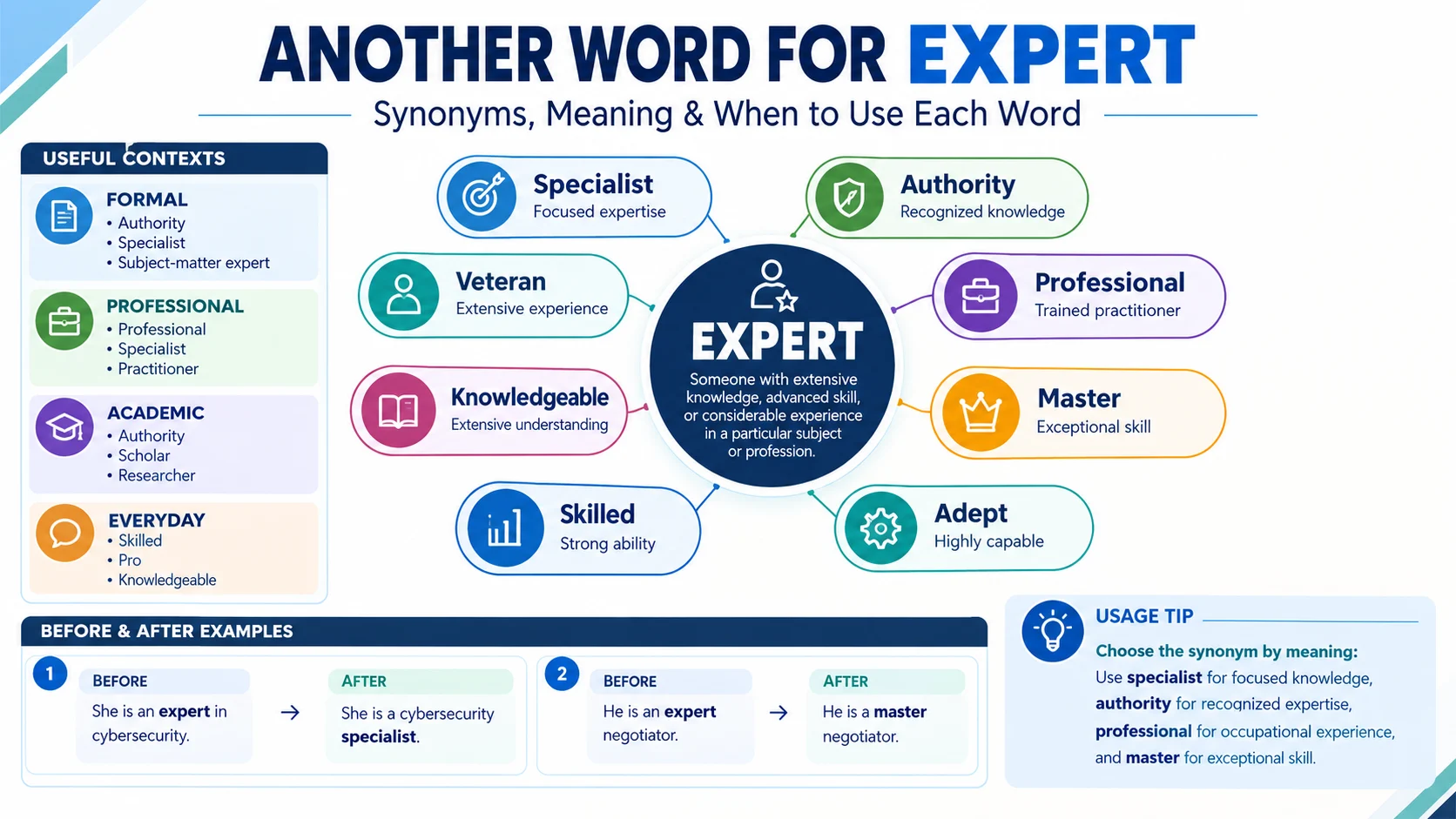
Another word for expert is specialist, authority, professional, master, adept, skilled, knowledgeable, or veteran. The best choice depends on context: use specialist for focused expertise, authority for recognized knowledge, and master for exceptional skill.
What Does Expert Mean?
Definition
An expert is a person who has extensive knowledge, advanced skill, or considerable experience in a particular subject, profession, or activity. The word can describe someone recognized for knowing a field particularly well or performing a task at a high level.
For example:
She is an expert in digital marketing.
Depending on the context, alternatives such as specialist, professional, authority, master, specialist, adept, skilled, or knowledgeable can provide a more precise meaning.
Common Uses
The word expert commonly describes people who have:
- Advanced knowledge of a subject
- Professional training or experience
- Exceptional practical skills
- Specialized knowledge in a particular field
- A strong reputation for competence
Expert works in professional, academic, business, technical, and everyday contexts.
Best Synonyms for Expert
| Synonym | Meaning | Best Used When | Example |
|---|---|---|---|
| Specialist | Someone with specialized knowledge | A person focuses on a specific field | She is a cybersecurity specialist. |
| Professional | Someone trained or experienced in a profession | Discussing workplace expertise | He is a professional photographer. |
| Authority | A person recognized as highly knowledgeable | Formal or academic writing | She is an authority on constitutional law. |
| Master | Someone exceptionally skilled | Emphasizing outstanding ability | He is a master of classical piano. |
| Adept | Highly capable or skillful | Describing strong practical ability | She is adept at solving complex problems. |
| Specialist | Someone concentrating on a narrow area | Technical or professional contexts | The company hired a tax specialist. |
| Skilled | Having strong ability or training | Simple descriptions of competence | He is a skilled engineer. |
| Knowledgeable | Having substantial knowledge | When emphasizing understanding | She is knowledgeable about renewable energy. |
| Veteran | Someone with extensive experience | Emphasizing years of experience | The veteran journalist covered the election. |
| Connoisseur | A knowledgeable and discerning enthusiast | Art, food, wine, or luxury subjects | He is a connoisseur of fine art. |
Synonyms by Context
Formal Writing
For formal writing, the best alternatives are often authority, specialist, expert, authority in the field, and subject-matter expert.
Example:
Dr. Carter is a leading authority on environmental economics.
“Authority” is stronger than simply saying someone is knowledgeable because it suggests that the person is recognized within a particular field.
Professional Writing
In business and workplace communication, use specialist, professional, consultant, practitioner, skilled professional, or subject-matter expert.
Example:
We consulted a financial specialist before making the investment decision.
These alternatives can sound more specific and professional than repeatedly using “expert.”
Academic Writing
Academic writing often favors specialist, scholar, authority, researcher, subject-matter expert, or leading researcher, depending on the person’s actual role.
Example:
The study draws on research by several leading authorities in molecular biology.
Avoid calling someone an “authority” unless the context supports that level of recognition.
Daily Conversation
In everyday speech, natural alternatives include pro, whiz, master, skilled person, and someone who really knows their stuff.
Example:
Mike is a computer whiz. He can fix almost anything.
“Pro” is particularly common in informal American English.
Professional Alternatives for Expert
If you are writing a resume, LinkedIn profile, business document, proposal, or professional biography, consider using a more precise term instead of “expert.”
Specialist
Meaning: A person with advanced knowledge in a particular area.
Best used for: Resumes, job descriptions, business profiles, and technical writing.
Example:
Cybersecurity specialist with 10 years of experience in network protection.
Subject-Matter Expert
Meaning: A person with deep knowledge of a particular subject or business area.
Best used for: Corporate, technical, consulting, and project-management contexts.
Example:
Served as the subject-matter expert for the company’s data analytics platform.
Authority
Meaning: A person widely recognized for knowledge in a particular field.
Best used for: Academic, professional, journalistic, and formal contexts.
Example:
She is a recognized authority on consumer behavior.
Professional
Meaning: Someone trained or experienced in a particular occupation or activity.
Best used for: Business profiles, resumes, services, and customer-facing writing.
Example:
We provide professional consulting services to small businesses.
Simple Alternatives for Expert
If your audience prefers plain, accessible language, these words are useful:
- Skilled
- Experienced
- Knowledgeable
- Trained
- Pro
- Specialist
- Talented
- Capable
For example, instead of:
She is an expert at managing teams.
You could write:
She is highly skilled at managing teams.
Or:
She is experienced in managing teams.
“Skilled” is especially useful when you want simple, direct language.
Stronger Alternatives for Expert
When the context genuinely supports an especially high level of ability or recognition, consider:
- Master
- Authority
- Leading specialist
- Subject-matter expert
- Highly accomplished professional
- Veteran
- Master practitioner
Be careful with stronger terms. Calling someone a “master” or “leading authority” makes a stronger claim than simply calling them an expert.
Important Synonym Analysis
Specialist
Meaning: Someone who concentrates on a particular area of knowledge or work.
Best Used For: Technical professions and narrowly focused expertise.
Tone: Professional
Difficulty: Easy
Usage Frequency: Common
Best For: Resumes, business writing, academic writing, professional profiles
Business Example:
Our team hired a logistics specialist to improve supply-chain efficiency.
Academic Example:
The researcher is a specialist in medieval literature.
Daily Conversation:
She is a specialist in repairing vintage watches.
Authority
Meaning: A person recognized for extensive knowledge or expertise.
Best Used For: Established recognition within a field.
Tone: Formal
Difficulty: Medium
Usage Frequency: Common
Best For: Academic writing, journalism, formal business writing
Business Example:
He is considered an authority on corporate compliance.
Academic Example:
The professor is an authority on Renaissance literature.
Daily Conversation:
She is an authority on local history.
Professional
Meaning: A trained, experienced, or qualified person.
Best Used For: Occupations, services, and workplace contexts.
Tone: Professional and neutral
Difficulty: Easy
Usage Frequency: Very Common
Best For: Resumes, emails, marketing copy, business writing
Business Example:
We hired a professional consultant to review the strategy.
Academic Example:
The program prepares students for professional practice.
Daily Conversation:
He is a professional photographer.
Master
Meaning: A person with exceptional skill or command of something.
Best Used For: Exceptional ability, particularly in an artistic, technical, or traditional skill.
Tone: Strong
Difficulty: Easy
Usage Frequency: Common
Best For: Marketing copy, biographies, creative writing, informal descriptions
Business Example:
She is a master negotiator.
Academic Example:
The artist became a master of portrait painting.
Daily Conversation:
He’s a master at fixing old cars.
Difference Between Similar Synonyms
Although these words can replace expert, they are not always interchangeable.
Expert vs. Specialist:
An expert has advanced knowledge or skill, while a specialist focuses on a particular area. A specialist may be an expert, but specialization and expertise describe different qualities.
Expert vs. Professional:
A professional is associated with training, occupation, or paid work. A person can be an expert without being a professional.
Expert vs. Authority:
An authority is generally someone whose expertise is recognized by others. “Authority” therefore often carries a stronger implication of reputation.
Expert vs. Master:
A master suggests an exceptionally high degree of skill. It is often more emphatic than “expert.”
Expert vs. Skilled:
“Skilled” describes ability, while “expert” generally suggests a higher level of knowledge, experience, or competence.
Expert vs. Knowledgeable:
Someone knowledgeable knows a great deal about a subject, but “expert” usually implies deeper expertise, practical experience, or recognized competence.
Choosing the Right Word
Use expert when you need a broad, neutral term for someone with advanced knowledge or skill.
Use specialist when the person’s expertise is concentrated in a particular field.
Use authority when the person is recognized for substantial knowledge or influence in that subject.
Use professional when training, occupation, or professional experience is the main point.
Use master when emphasizing exceptional skill.
Use adept when describing someone’s ability to perform a particular task effectively.
Use veteran when years of experience are more important than specialized knowledge.
Use knowledgeable when you want a softer and more accessible description.
Opposite Words
Depending on context, possible opposites of expert include:
- Novice
- Beginner
- Amateur
- Inexperienced person
- Learner
- Nonexpert
- Unskilled person
The exact opposite depends on what “expert” means in the sentence. For example, novice emphasizes limited experience, while amateur can mean someone who participates without professional status.
FAQs
What is another word for expert?
Common alternatives for expert include specialist, professional, authority, master, adept, skilled, knowledgeable, and veteran. The best replacement depends on whether you want to emphasize knowledge, professional experience, specialization, or exceptional skill.
What is a formal synonym for expert?
Authority and specialist are strong formal alternatives. “Subject-matter expert” is also widely used in professional and technical contexts.
What is a professional alternative for expert?
Useful professional alternatives include specialist, subject-matter expert, professional, consultant, practitioner, and authority, depending on the person’s role and qualifications.
What word can replace expert on a resume?
Good resume alternatives include specialist, professional, skilled, accomplished, experienced, practitioner, and subject-matter expert. Choose a word that accurately reflects your actual experience rather than simply using the strongest-sounding term.
What is a simple word for expert?
Skilled, pro, experienced, and knowledgeable are simple alternatives. “Pro” is informal, while “skilled” and “experienced” work well in more general writing.
What is another word for an expert in a field?
Specialist, authority, subject-matter expert, specialist practitioner, and leading researcher can work depending on the field and the person’s documented role.
Is “professional” the same as “expert”?
Not always. Professional usually describes someone’s occupation, training, or professional status, whereas expert emphasizes advanced knowledge or skill. A professional may not necessarily be an expert.
Conclusion
The best synonym for expert depends on the meaning you want to emphasize. Specialist highlights focused knowledge, authority suggests recognized expertise, professional emphasizes occupation or training, master highlights exceptional skill, and skilled provides a simple, accessible alternative.
For resumes and professional writing, choose the most precise term rather than automatically replacing every occurrence of “expert.” A specific description of the person’s skills, experience, or field of knowledge is often more informative than a stronger-sounding synonym.
