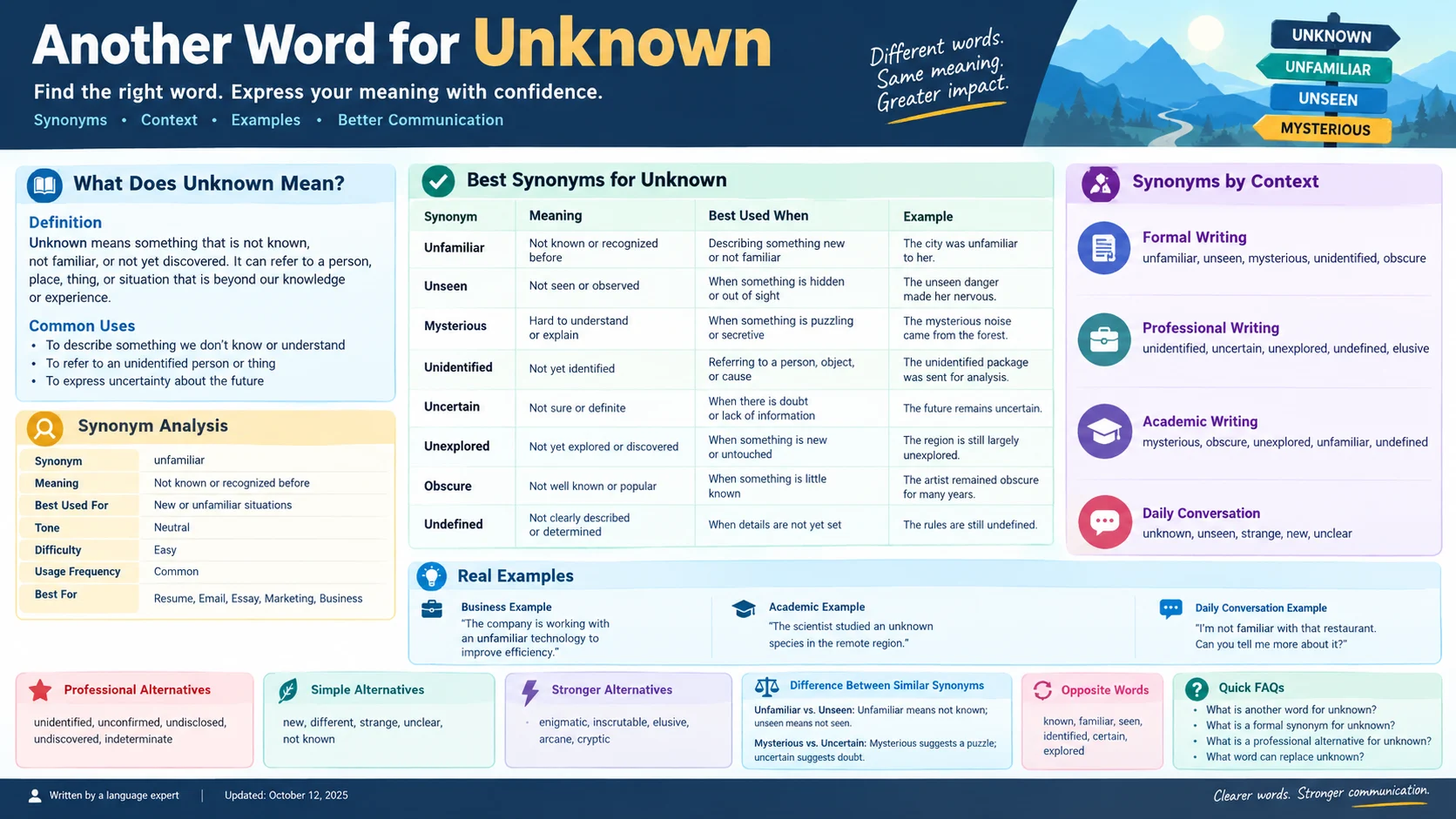
Another word for unknown is unfamiliar, unidentified, unrecognized, mysterious, or unexplored. The best synonym depends on your context. Use unfamiliar for something you do not recognize, unidentified for a person or thing whose identity is not established, and mysterious for something difficult to explain or understand.
What Does Unknown Mean?
Definition
The adjective unknown describes a person, thing, place, fact, or situation that is not known, recognized, identified, or understood. It can also refer to something that has not yet been discovered or experienced.
For example, an unknown author may be someone whose identity is not widely recognized. An unknown destination is a place whose location or characteristics are not familiar. An unknown outcome is a result that has not yet been determined.
The word can also function as a noun. In everyday English, the unknown refers to something unfamiliar or uncertain.
Common Uses
People use unknown in several contexts:
- Identity: An unknown caller contacted the office.
- Knowledge: The cause of the problem remains unknown.
- Discovery: Researchers explored an unknown region.
- Uncertainty: The team prepared for the unknown.
- Recognition: The unknown writer published a remarkable first novel.
Understanding the intended meaning helps you select a more precise synonym.
Best Synonyms for Unknown
The following synonyms are useful in American English, but they are not interchangeable in every sentence.
| Synonym | Meaning | Best Used When | Example |
|---|---|---|---|
| Unfamiliar | Not known through experience or recognition | Describing something new to someone | The software was unfamiliar to the team. |
| Unidentified | Not yet recognized or established by identity | Referring to a person, object, or cause | An unidentified package arrived. |
| Mysterious | Difficult to explain or understand | Describing something puzzling | A mysterious sound came from the basement. |
| Unrecognized | Not identified, acknowledged, or appreciated | Discussing identity or recognition | The contribution went unrecognized. |
| Unexplored | Not yet investigated or visited | Discussing places, ideas, or possibilities | The region remains largely unexplored. |
| Unseen | Not seen or observed | Referring to something hidden from view | An unseen force moved the curtain. |
| Uncertain | Not definite or known with confidence | Discussing outcomes or information | The project’s future remains uncertain. |
| Obscure | Not widely known or easily understood | Describing little-known facts or references | The article discussed an obscure historical event. |
| Undiscovered | Not yet found or recognized | Discussing hidden things or new findings | The cave may contain undiscovered passages. |
| Undefined | Not clearly specified or established | Discussing rules, terms, or boundaries | The project’s goals remain undefined. |
| Anonymous | Having an unknown or undisclosed identity | Referring to people or contributions | An anonymous donor funded the program. |
| Cryptic | Mysterious or difficult to interpret | Describing puzzling messages | She received a cryptic note. |
Synonyms for Unknown by Context
The most effective replacement depends on whether you are writing formally, professionally, academically, or conversationally.
Formal Writing
For formal writing, consider unidentified, unrecognized, obscure, undisclosed, and indeterminate.
These words communicate specific shades of meaning.
Example: “The source of the discrepancy remains unidentified.”
Use obscure when something is little known or difficult to understand, rather than simply unfamiliar to one individual.
Professional Writing
Professional writing benefits from precise, neutral vocabulary. Depending on the situation, suitable alternatives include unidentified, unconfirmed, uncertain, undefined, and undisclosed.
Examples:
- Business: “The cause of the delay remains unidentified.”
- Project management: “Several requirements are still undefined.”
- Risk assessment: “The financial impact remains uncertain.”
- Human resources: “The applicant requested an undisclosed salary range.”
For resumes, avoid replacing unknown with an impressive-sounding word that changes the meaning. Instead, describe your actual contribution, such as “researched an unfamiliar market” or “investigated an unidentified performance issue.”
Academic Writing
Useful alternatives include unexplored, undetermined, unidentified, unexamined, and undocumented.
Examples:
- “The relationship between the variables remains undetermined.”
- “Previous research has left this question largely unexplored.”
- “The phenomenon remains undocumented in the available literature.”
Choose the word that accurately represents the evidence.
Daily Conversation
In everyday conversations, simpler words often sound more natural.
Consider new, unfamiliar, strange, unclear, or not known.
Examples:
- “This neighborhood is unfamiliar to me.”
- “We are visiting a new place.”
- “The instructions are unclear.”
- “Nobody knows who called.”
Professional Alternatives for Unknown
If you need a professional alternative for unknown, start by identifying what is actually unknown.
| Situation | Recommended Alternative | Example |
|---|---|---|
| Identity has not been established | Unidentified | The unidentified source provided the information. |
| Information has not been verified | Unconfirmed | The reported figures remain unconfirmed. |
| Details have not been specified | Undefined | The project’s scope is still undefined. |
| A result cannot yet be predicted | Uncertain | The outcome remains uncertain. |
| Information is intentionally withheld | Undisclosed | The terms of the agreement remain undisclosed. |
| A cause has not been determined | Undetermined | The cause of the failure is undetermined. |
Resume tip: Rather than writing “worked on unknown challenges,” use specific language such as “investigated unfamiliar technical issues” or “researched an emerging market.” Specific descriptions communicate skills and accomplishments more effectively.
Simple Alternatives for Unknown
For children, beginning writers, and everyday communication, these alternatives are easy to understand:
- New: Something encountered for the first time.
- Unfamiliar: Something you do not recognize or know well.
- Strange: Something unusual or unexpected.
- Unclear: Something that is difficult to understand.
- Not known: A straightforward description of missing knowledge.
Example: Instead of “The destination was unknown to us,” write “We had never been to that place before.”
The second sentence is more conversational and may be easier for younger readers to understand.
Stronger Alternatives for Unknown
When you want a more expressive word, consider enigmatic, cryptic, inscrutable, elusive, or unfathomable. These words add specific shades of meaning rather than simply making a sentence stronger.
- Enigmatic: Mysterious and difficult to interpret. “The artist maintained an enigmatic public image.”
- Cryptic: Difficult to understand because the meaning is concealed or unclear. “The message contained a cryptic warning.”
- Inscrutable: Difficult to understand or interpret, especially someone’s expression, behavior, or motives. “His reaction remained inscrutable.”
- Elusive: Difficult to find, catch, define, or achieve. “A reliable explanation remained elusive.”
- Unfathomable: Extremely difficult to understand or comprehend. “The scale of the universe seemed unfathomable.”
These alternatives are most effective when their precise meanings fit the sentence. For ordinary situations, unfamiliar or unidentified is usually more accurate than inscrutable or unfathomable.
Difference Between Similar Synonyms
Some synonyms for unknown appear interchangeable but express different ideas.
Unknown vs. Unfamiliar
Unknown can mean not known at all or not identified. Unfamiliar emphasizes a lack of personal experience or recognition.
Example: “The name was unknown to the public, but the topic was unfamiliar to me.”
Unknown vs. Unidentified
Unknown is broad, while unidentified specifically indicates that an identity has not been established.
Example: “An unknown person entered the building” is broad. “An unidentified person entered the building” emphasizes that the person’s identity has not been confirmed.
Unknown vs. Mysterious
Unknown describes a lack of knowledge. Mysterious suggests that something is puzzling, secretive, or difficult to explain.
Example: “The cause is unknown” states a fact. “The cause is mysterious” adds a sense of intrigue.
Unknown vs. Uncertain
Unknown concerns missing knowledge or identification.
Example: “The winner is unknown” means nobody has established who won. “The winner is uncertain” suggests that the outcome has not been decided or cannot yet be predicted.
Unknown vs. Obscure
Unknown can refer to anything not known. Obscure often describes something that is little known, difficult to understand, or not prominent.
Example: “The researcher discovered an obscure historical document.”
Opposite Words of Unknown
The best antonym depends on the meaning of unknown in the original sentence.
| Antonym | Meaning | Example |
|---|---|---|
| Known | Recognized or understood | The cause is known. |
| Familiar | Recognized through experience | The route is familiar. |
| Identified | Recognized or named | The source has been identified. |
| Recognized | Identified or acknowledged | Her work is widely recognized. |
| Certain | Established or free from relevant doubt | The result is certain. |
| Discovered | Found or learned about | The previously hidden site was discovered. |
Known is the most direct general antonym. However, identified is more precise when discussing identity, while familiar is appropriate when discussing personal experience.
FAQs
What is another word for unknown?
Common alternatives include unfamiliar, unidentified, unrecognized, mysterious, unexplored, and uncertain.
What is a formal synonym for unknown?
Unidentified, undetermined, indeterminate, and undisclosed can work in formal writing. Use each only when its meaning matches the context.
What is a professional alternative for unknown?
In professional writing, unconfirmed, unidentified, uncertain, and undefined are useful alternatives. For example, write “The cause remains unidentified” instead of “The cause is unknown” when the focus is on identifying a cause.
What word can replace unknown in an essay?
Consider unexplored, unexamined, undocumented, undetermined, or unidentified.
What is another word for an unknown person?
Depending on the situation, use unidentified person, anonymous individual, or stranger.
What is a synonym for unknown in science?
Scientific writing may use undetermined, unidentified, uncharacterized, unexamined, or unexplored. The appropriate term depends on whether researchers have yet to establish a value, identify an entity, describe a property, or investigate a subject.
What is a positive synonym for unknown?
Unexplored can suggest opportunity, while undiscovered may imply potential for new findings. For example, “The company sees opportunity in an unexplored market” presents the unknown as a possibility rather than a problem.
What is the opposite of unknown?
The most common opposite is known. Other alternatives include familiar, identified, recognized, and certain, depending on the intended meaning.
Conclusion
The best synonym for unknown is the one that expresses your intended meaning precisely. Use unfamiliar for something new to you, unidentified for something whose identity has not been established, mysterious for something puzzling, and uncertain for an unsettled outcome.
For academic and professional writing, choose specific terms such as undetermined, unconfirmed, or undisclosed when they accurately describe the situation. For everyday conversation, new, strange, or not known may be clearer.
