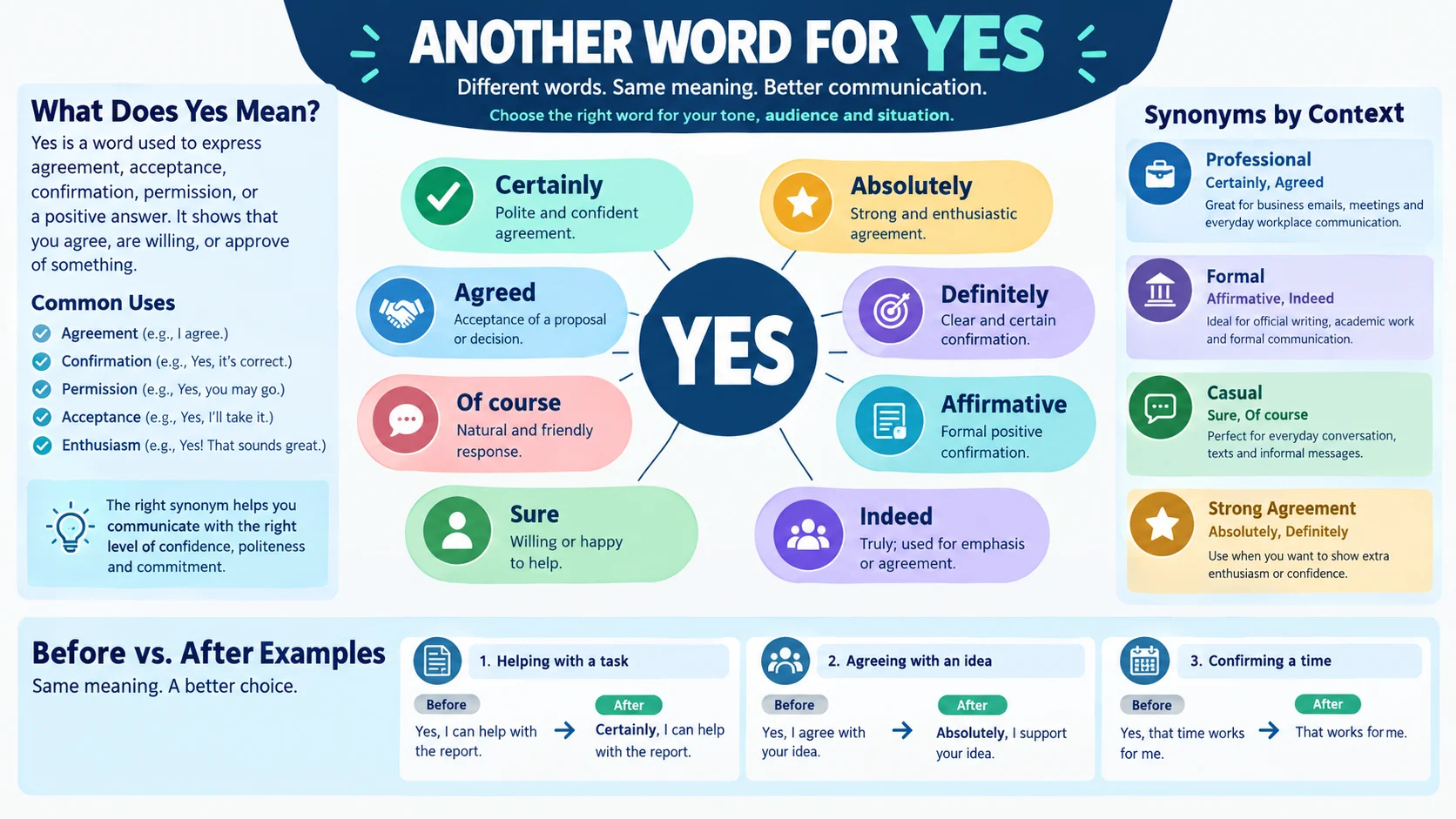
Another word for yes is certainly, absolutely, indeed, definitely, agreed, affirmative, or of course. The best alternative depends on your meaning and situation. Use certainly for polite agreement, absolutely for strong enthusiasm, affirmative for formal confirmation, and agreed when accepting a proposal or decision.
What Does Yes Mean?
Definition
Yes is an adverb or response word used to express agreement, acceptance, confirmation, permission, or a positive answer to a question. It can also indicate willingness to participate or approve a suggestion.
For example, if someone asks, “Can you attend the meeting?” answering “Yes” confirms your availability. Saying “Certainly” sounds more polished, while “Absolutely” conveys greater enthusiasm.
Common Uses
The word yes appears in everyday conversation, professional emails, academic discussions, customer service, negotiations, and formal decision-making. Its meaning can shift slightly according to context.
- Agreement: “Yes, I agree with your recommendation.”
- Confirmation: “Yes, the payment was received.”
- Permission: “Yes, you may submit the assignment tomorrow.”
- Acceptance: “Yes, I accept the offer.”
- Enthusiasm: “Absolutely! I’d love to join you.”
Choosing a suitable synonym makes your response more precise and helps communicate the right level of confidence, politeness, or commitment.
Best Synonyms for Yes
The following alternatives are useful for writers, students, professionals, and anyone looking for another word for yes.
| Synonym | Meaning | Best Used When | Example |
|---|---|---|---|
| Certainly | Without doubt; willingly | Polite or professional replies | Certainly, I can help. |
| Absolutely | Completely; definitely | Strong agreement | Absolutely, that’s a great idea. |
| Definitely | Without uncertainty | Clear confirmation | I will definitely attend. |
| Of course | Naturally; willingly | Friendly or reassuring replies | Of course, you can borrow it. |
| Indeed | Truly; certainly | Formal emphasis or confirmation | Indeed, the results support our claim. |
| Affirmative | Expressing a positive answer | Official or procedural communication | The answer is affirmative. |
| Agreed | In accordance with a proposal | Decisions and negotiations | Agreed, we’ll proceed on Monday. |
| Sure | Willing or certain | Informal conversation | Sure, I’ll send it today. |
| Okay | Acceptable; approved | Everyday communication | Okay, let’s get started. |
| Correct | Accurate or true | Checking facts | Correct, the meeting starts at nine. |
| Precisely | Exactly; accurately | Confirming a specific point | Precisely, that’s what I meant. |
| Definitely so | Certainly true | Emphatic confirmation | Definitely so; the evidence is clear. |
| Gladly | Willingly and happily | Offering help | Gladly, I’ll review your draft. |
| Without a doubt | With complete certainty | Strong conviction | Without a doubt, she’s qualified. |
| I agree | Sharing the same opinion | Discussions and debates | I agree with your conclusion. |
| I accept | Formally receiving or approving | Offers and invitations | I accept the position. |
| Approved | Officially authorized | Business and administrative contexts | Your request is approved. |
| Granted | Permission has been given | Formal permission | Granted, you may leave early. |
Not every synonym fits every sentence. Approved implies authority, I accept communicates a decision, and correct verifies accuracy. Use the word that matches your intended meaning rather than replacing yes mechanically.
Synonyms for Yes by Context
The best replacement for yes depends on your audience, purpose, and desired tone. A word that works in a friendly text message may sound too casual in a business proposal.
Formal Writing
For formal letters, official communication, and academic responses, choose alternatives that communicate clarity and professionalism.
- Affirmative: Suitable for official confirmations and procedural answers. Example: “The response to the proposal is affirmative.”
- Certainly: Polite and professional. Example: “Certainly, I will provide the requested documentation.”
- Indeed: Useful for reinforcing a statement. Example: “Indeed, the findings demonstrate a meaningful improvement.”
- I concur: A formal way to express agreement with an opinion. Example: “I concur with the committee’s recommendation.”
For most formal writing, certainly and I concur are more natural than affirmative, which can sound technical or procedural.
Professional Writing
In business emails, workplace discussions, and client communication, your response should make your agreement or commitment clear.
- Agreed: “Agreed, we will implement the revised schedule.”
- Absolutely: “Absolutely, we can accommodate your request.”
- Approved: “Your proposed budget is approved.”
- Confirmed: “Your appointment is confirmed for Thursday.”
- Happy to: “I’m happy to assist with the onboarding process.”
Notice that confirmed communicates that an arrangement is established, while approved indicates authorization. Neither is a universal replacement for yes.
Academic Writing
Students and researchers often need alternatives that express agreement without making an informal response sound overly conversational.
- Indeed: “Indeed, the evidence supports the original hypothesis.”
- I agree: “I agree with the author’s interpretation of the results.”
- That is correct: “That is correct; the second equation follows from the first.”
- This is supported: “This interpretation is supported by the available evidence.”
In formal academic prose, it is often better to state the specific claim directly than to begin every response with yes.
Daily Conversation
Everyday speech usually calls for simple, natural alternatives.
- Sure: “Sure, I’ll meet you there.”
- Of course: “Of course, you can sit with us.”
- Absolutely: “Absolutely! Let’s do it.”
- You bet: “You bet, I’ll bring the snacks.”
- Sounds good: “Sounds good; see you at six.”
- No problem: “No problem, I can help.”
These expressions have slightly different tones. You bet is casual and friendly, while sounds good signals acceptance of a suggestion or plan.
Professional Alternatives for Yes
If you want a professional alternative to yes, choose a phrase that communicates your actual decision.
| Situation | Professional alternative | Example |
|---|---|---|
| Accepting a task | Certainly | Certainly, I’ll prepare the report. |
| Agreeing with a proposal | Agreed | Agreed, we’ll use the updated plan. |
| Confirming information | Confirmed | Confirmed, the files have been received. |
| Accepting a job offer | I accept | I accept the position under the stated terms. |
| Granting permission | Approved | Your request to work remotely is approved. |
| Offering assistance | Happy to help | I’m happy to help with the presentation. |
| Confirming a scheduled event | That works for me | Thursday at 2 p.m. works for me. |
For resumes, yes is rarely the strongest word because resumes typically describe accomplishments rather than answer questions. Instead of writing “Yes, I can manage projects,” write “Managed cross-functional projects and coordinated delivery timelines.” This demonstrates the skill directly.
For email writing, certainly and happy to help are useful for polite responses. For negotiations, agreed is appropriate when you genuinely accept the proposed terms.
Simple Alternatives for Yes
If you want an easy word that sounds natural, start with these options:
- Sure: A friendly, informal acceptance.
- Okay: Acceptance or acknowledgment.
- Yep: A casual version of yes.
- Of course: A reassuring or willing response.
- Definitely: A clear expression of certainty.
- Right: Agreement or confirmation, depending on context.
- Sounds good: Acceptance of a suggestion or arrangement.
Examples:
- Instead of “Yes, I can come,” write “Sure, I can come.”
- Instead of “Yes, that plan is acceptable,” write “Okay, that works.”
- Instead of “Yes, let’s meet tomorrow,” write “Sounds good; let’s meet tomorrow.”
For school assignments and professional communication, sure and okay are useful but can be too informal in some situations. When in doubt, use certainly or give a direct answer.
Stronger Alternatives for Yes
Some expressions communicate more confidence or enthusiasm than a plain yes.
| Alternative | Strength | Example |
|---|---|---|
| Absolutely | Strong, enthusiastic agreement | Absolutely, I support this initiative. |
| Definitely | Clear certainty | I’ll definitely be there. |
| Without a doubt | Very strong confidence | Without a doubt, this is the right approach. |
| Wholeheartedly | Sincere, enthusiastic support | I wholeheartedly support the proposal. |
| Unequivocally | Clear and unambiguous agreement | We unequivocally endorse the recommendation. |
| I fully agree | Strong agreement with an opinion | I fully agree with your assessment. |
Unequivocally is an advanced word suited to formal statements, while absolutely is more versatile in everyday and professional speech. Avoid stronger alternatives when you are uncertain or only partially agree.
Difference Between Similar Synonyms
Although many words can replace yes, their meanings are not identical.
| Word | Main distinction | Example |
|---|---|---|
| Certainly | Polite willingness or confidence | Certainly, I’ll assist. |
| Absolutely | Enthusiastic or emphatic agreement | Absolutely, that’s correct. |
| Indeed | Reinforces a statement | Indeed, the results are promising. |
| Affirmative | Explicit positive confirmation | The answer is affirmative. |
| Agreed | Acceptance of a proposal or shared position | Agreed, we’ll revise the plan. |
| Confirmed | Establishes or verifies information | Confirmed, your booking is complete. |
| Approved | Indicates authorization | The application is approved. |
| Sure | Informal willingness or agreement | Sure, I’ll take a look. |
The distinction matters because agreement, confirmation, permission, and enthusiasm are related but different ideas.
For example, answering “Absolutely” to “Do you support this idea?” expresses enthusiasm. Answering “Confirmed” to “Is the appointment scheduled?” verifies a fact. Answering “Approved” to “May I proceed?” suggests that someone with authority has granted permission.
Opposite Words of Yes
The most direct opposite of yes is no. However, other expressions communicate refusal, disagreement, or uncertainty depending on the situation.
| Opposite or alternative | Meaning | Example |
|---|---|---|
| No | Negative answer | No, I cannot attend. |
| Not at all | Negative response to a particular proposition | Not at all, I disagree with that assumption. |
| Never | At no time; strong rejection in some contexts | I would never agree to those terms. |
| Declined | Refused an offer or invitation | She declined the invitation. |
| Disagree | Hold a different opinion | I disagree with the conclusion. |
| Negative | Formal or procedural rejection | The response was negative. |
| Uncertain | Not sure of the answer | I’m uncertain whether that will work. |
These words are not interchangeable in every situation. Uncertain expresses doubt rather than a definite refusal, while declined describes rejecting an offer or request.
FAQs
What is another word for yes?
Common alternatives include certainly, absolutely, definitely, indeed, sure, and of course. The best choice depends on whether you want to express agreement, confidence, permission, or enthusiasm.
What is a formal synonym for yes?
Certainly, affirmative, indeed, and I concur can work in formal contexts. Choose affirmative for procedural communication and I concur when formally agreeing with an opinion.
What is a professional alternative for yes?
Certainly, agreed, confirmed, approved, and happy to help are useful professional alternatives. Select the phrase according to whether you are accepting a task, confirming information, authorizing a request, or offering assistance.
What word can replace yes in an email?
Use certainly for polite agreement, absolutely for enthusiastic support, agreed for accepting a proposal, and that works for me for scheduling. A direct response often sounds more natural than an unnecessarily formal synonym.
What is a stronger word for yes?
Absolutely, definitely, wholeheartedly, and unequivocally can express stronger agreement or confidence. Absolutely is usually the most versatile option, while unequivocally is better suited to formal writing.
Is “sure” a synonym for yes?
Yes. Sure commonly expresses willingness or agreement in informal American English. For example, “Sure, I’ll help you” means the speaker is willing to help. In highly formal situations, certainly may be more appropriate.
What is another way to say yes without saying yes?
You can say “That works for me,” “Sounds good,” “I’m happy to,” “I agree,” or “You have my approval.” Each phrase communicates a particular kind of acceptance without using the word yes.
Conclusion
The best synonym for yes depends on what you want to communicate. Use certainly for polite professionalism, absolutely for enthusiasm, agreed for decisions, affirmative for formal confirmation, and sure for casual conversation.
When choosing another word for yes, consider your audience, tone, and intended meaning. A precise alternative makes your writing clearer, more natural, and more effective.
