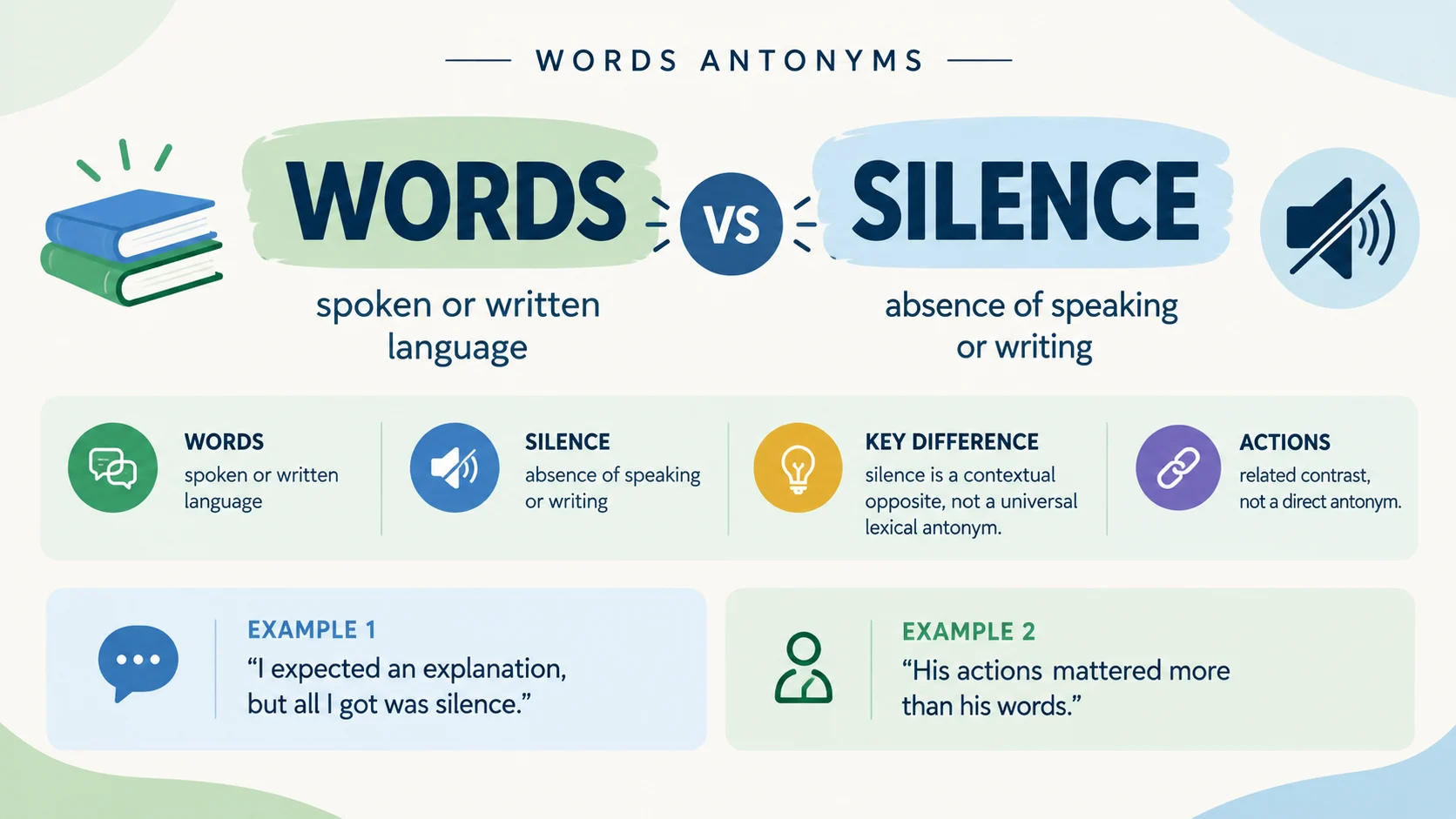
There is no single direct antonym for words. When words means spoken or written language used to communicate, silence is the strongest contextual opposite because it describes an absence of speaking or writing. In other senses, the contrast changes. For example, actions can contrast with words when discussing what someone does versus what someone says.
Direct and Strong Antonyms
Unlike adjectives such as hot and cold, words does not have a standard lexical antonym. A word can mean a unit of language, a statement, a message, a promise, or an order, so one opposite cannot cover every sense.
For that reason, a reliable guide should not present a long list of unrelated terms as direct antonyms. The strongest choices are contextual:
| Opposite or contrast | Classification | Tone or nuance | Example |
|---|---|---|---|
| Silence | Contextual opposite | Neutral and direct | “After the question, the room fell into silence.” |
| Speechlessness | Contextual opposite | Stronger and often emotional | “The announcement left her speechless.” |
| Actions | Related contrast | Practical and commonly used | “His actions mattered more than his words.” |
Only silence functions as a broad contextual opposite when words means communication. Speechlessness is narrower because it describes an inability or failure to speak. Actions is not a true antonym. It is a conventional contrast between what someone says and what someone does.
Contextual and Subtle Opposites
The best opposite of words depends on what words means in the sentence.
When words means spoken or written communication
Best contextual opposite: silence
When words refers to speaking, writing, or verbal expression, silence provides the clearest contrast. It describes a state in which communication through speech or writing is absent.
Example: “I expected an explanation, but all I got was silence.”
When words means talking or statements
Best contextual opposite: silence or speechlessness
If someone says, “I have no words,” the intended idea may be an inability to express a reaction. Speechlessness can fit when emotion, surprise, or shock prevents someone from speaking.
Example: “The unexpected award left him speechless.”
However, speechlessness is not simply the opposite of every use of words. It describes a condition, not a lexical category.
When words means deeds or promises in a comparison
Best related contrast: actions
The familiar contrast “words versus actions” describes a difference between what a person says and what the person actually does. It is useful in everyday American English, but it should not be labeled a direct antonym relationship.
Example: “She was tired of hearing promises and wanted to see actions.”
When words means news or a message
There is no fixed antonym. The natural contrast is often no response, no message, or silence, depending on the situation.
Example: “We have had no word from the contractor all week.”
Here, word means news or a message rather than a basic unit of language.
When word means a promise
The expression keep your word means to keep a promise. Its natural opposite is break your word or break a promise, but this is a relationship involving a promise rather than a direct antonym of word itself.
Example: “He gave me his word, and he kept it.”
Words That Seem Opposite But Are Not
Actions
Actions often appears beside words, especially in the familiar idea that actions can demonstrate whether someone means what they say. But actions are not the opposite meaning of words. They are another form of behavior or expression that can be contrasted with verbal statements.
Compare:
“Her words sounded reassuring.”
“Her actions showed that she was concerned.”
The two can disagree, but neither is the dictionary opposite of the other.
Nonverbal communication
Nonverbal communication includes facial expressions, gestures, posture, eye contact, and other signals. It can contrast with verbal communication, but it is not an antonym for words. Someone can use words and nonverbal signals at the same time.
Example: “His words were polite, but his tone and facial expression suggested frustration.”
Subtle Tone Differences
Choosing a contextual opposite requires attention to tone and strength.
Silence is the broadest and most neutral choice. It works for ordinary communication, unanswered questions, meetings, and moments when nobody speaks.
Speechlessness is more specific and usually suggests surprise, shock, emotion, or an inability to find words.
Actions shifts the comparison from language to behavior. It works especially well when evaluating whether someone followed through on what they said.
Consider these sentences:
“Her words stopped, and silence filled the room.”
“The announcement left everyone speechless.”
“His words promised change, but his actions stayed the same.”
Each sentence creates a different contrast. Replacing one term with another could change the meaning or emotional emphasis.
Frequently Asked Questions
What is the direct antonym of words?
There is no single standard direct antonym for words. When words means spoken or written communication, silence is the strongest contextual opposite. The exact contrast changes when word means a promise, message, statement, or order.
What is the opposite of words when talking about communication?
Silence is usually the clearest opposite when words means verbal communication. If the sentence emphasizes an inability to speak because of shock or emotion, speechlessness may be more precise. Neither is a universal antonym for every meaning of word.
Is actions the opposite of words?
Not exactly. Actions is a related contrast, especially when comparing what someone says with what they do. In a sentence such as “Her actions spoke louder than her words,” the terms represent different forms of expression or behavior rather than true dictionary antonyms.
Conclusion
The phrase words antonyms can be misleading because words has several meanings and no single lexical opposite. Silence is the strongest contextual opposite when words means verbal communication, while speechlessness and actions serve narrower or related purposes.
Good word choice depends on the exact sense you want to express. Instead of treating every contrast as a true antonym, identify the meaning first and then choose the term that creates the intended relationship. What sentence are you trying to write with words?
