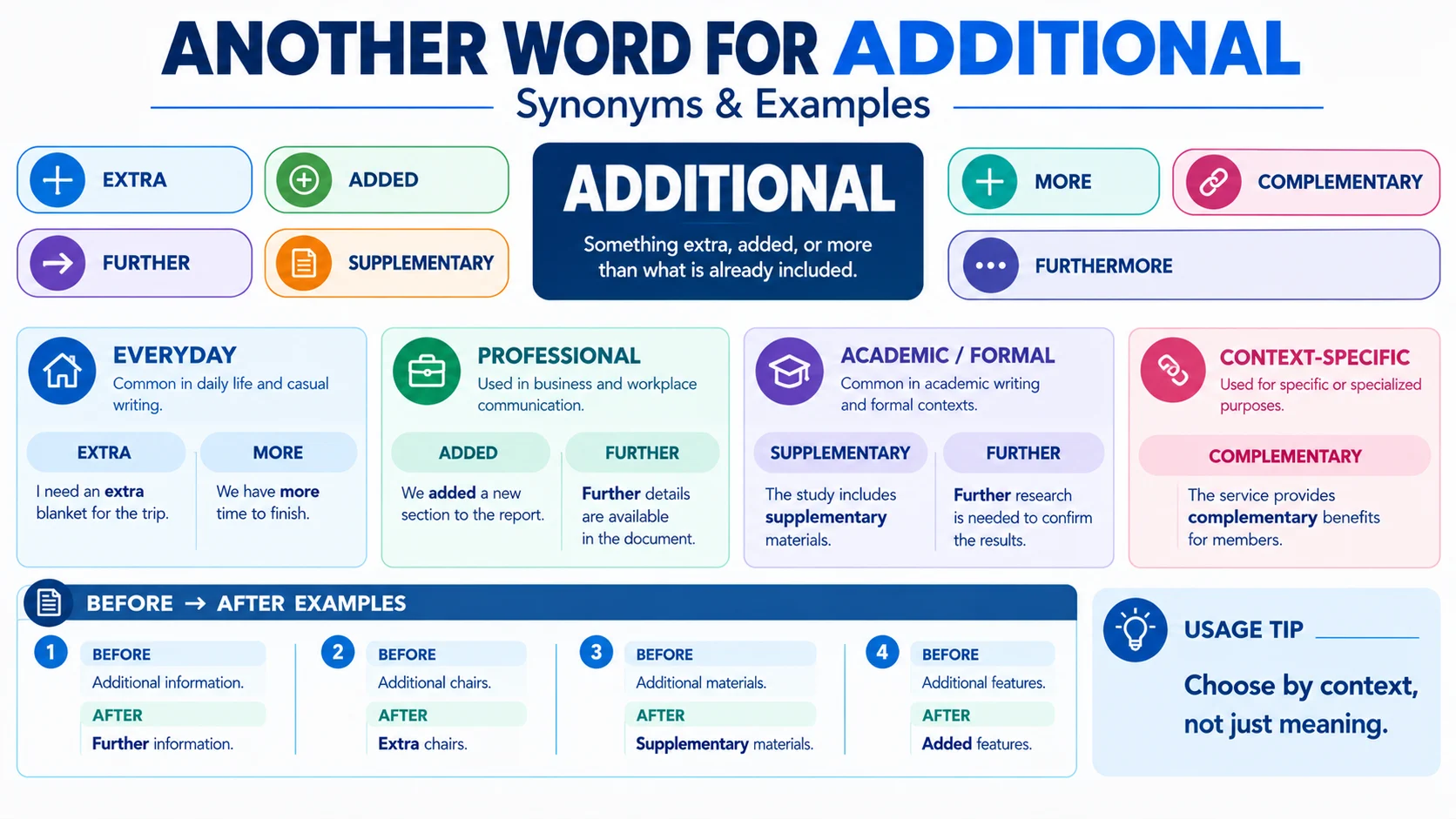
If you need another word for additional, the best choices include extra, added, further, supplementary, additional, more, and additional depending on context. Extra is the simplest everyday alternative, while supplementary works well in formal or academic writing. For professional writing, added and further are often natural replacements.
What Does Additional Mean?
Definition
Additional is an adjective meaning added to something that already exists or is already included. It describes something extra, further, or beyond what was originally provided, expected, or required.
For example:
The company offered additional training to new employees.
Here, additional means training provided in addition to the standard training.
Common Uses
The word additional commonly appears in:
- Business and professional writing
- Academic papers
- Instructions and reports
- Customer service communication
- Contracts and policies
- Everyday conversation
The best synonym depends on what you mean. Extra emphasizes something beyond the usual amount, while supplementary suggests something that supports or complements something else.
Best Synonyms for Additional
| Synonym | Meaning | Best Used When | Example |
|---|---|---|---|
| Extra | More than what is usual or expected | Everyday conversation | We need extra chairs. |
| Added | Included or provided in addition | Business and general writing | The package includes added features. |
| Further | More or additional | Formal and professional writing | Further information is available online. |
| Supplementary | Added to support or complete something | Academic and formal writing | Students received supplementary materials. |
| More | A greater amount or number | Simple, everyday language | We need more time. |
| Additional | Added beyond what already exists | General and formal writing | Additional fees may apply. |
| Extraordinary | Beyond what is ordinary | Describing unusual qualities, not simply quantity | She demonstrated extraordinary skill. |
| Complementary | Completing or enhancing something else | Services, products, and concepts | The course includes complementary resources. |
Important: Not every synonym is interchangeable in every sentence. For example, complementary usually means something that completes or enhances something else, while extra simply means more.
Synonyms by Context
Formal Writing
For formal documents, reports, and official communication, these alternatives work particularly well:
Further
Used to introduce more information, discussion, or action.
Further details will be provided after the review.
Supplementary
Used when something is added to support or complete a primary item.
The researchers provided supplementary data.
Added
Useful when emphasizing something that has been incorporated.
The revised policy includes added protections.
Additional itself is also highly appropriate for formal writing because it is precise and neutral.
Professional Writing
In business emails, reports, proposals, and workplace communication, consider:
- Further
- Added
- Extra
- Additional
- Supplementary
For example:
Please contact us if you require further assistance.
This sounds natural and professional. In contrast, extra assistance is more conversational.
Academic Writing
Academic writing often benefits from precise alternatives such as further, supplementary, and additional.
Examples:
Further research is needed to examine the results.
The study included supplementary materials.
Additional evidence supports this conclusion.
Further research is especially common in academic writing because it refers to research beyond the work already discussed.
Daily Conversation
In casual speech, extra and more are usually the most natural alternatives.
Do you need any extra help?
Can I have more information?
We brought some extra food.
Although additional is grammatically correct, it can sound more formal than necessary in casual conversation.
Professional Alternatives for Additional
Further
Meaning: More or additional.
Best Used For: Formal communication, business writing, academic writing.
Tone: Professional and formal.
Difficulty: Medium
Usage Frequency: Very Common
Best For: Resume writing, emails, essays, business writing.
Example:
Please provide further information about your qualifications.
Added
Meaning: Included beyond the original amount or version.
Best Used For: Business, product descriptions, reports, and general writing.
Tone: Neutral and professional.
Difficulty: Easy
Usage Frequency: Common
Best For: Business writing, marketing copy, reports.
Example:
The updated software provides added security features.
Supplementary
Meaning: Added to support or complement something primary.
Best Used For: Academic, technical, and formal contexts.
Tone: Formal.
Difficulty: Advanced
Usage Frequency: Common
Best For: Academic writing, research papers, reports.
Example:
Supplementary materials are available at the end of the report.
Simple Alternatives for Additional
If you want a simpler word, these are usually the best choices:
Extra
Extra is probably the most natural everyday substitute for additional.
Additional information → Extra information
Additional chairs → Extra chairs
More
More is even simpler when the sentence concerns quantity.
We need additional time.
We need more time.
Added
Added works when something has been included or incorporated.
Additional benefits → Added benefits
For most everyday writing, extra and more are easier and more conversational than additional.
Stronger Alternatives for Additional
If you want to emphasize that something goes beyond the original amount, consider extra, further, or supplementary.
Extra emphasizes something beyond what is normally provided.
Customers can purchase extra storage.
Further emphasizes continuation or additional development.
Further analysis revealed a different pattern.
Supplementary emphasizes support or enhancement.
The textbook includes supplementary exercises.
The strongest choice depends on the intended meaning rather than simply choosing the most sophisticated word.
Difference Between Similar Synonyms
Additional vs. Extra
Both mean something added beyond the original amount.
- Additional is more formal and neutral.
- Extra is more conversational.
Additional charges may apply.
There is an extra charge for delivery.
Additional vs. Further
Additional often describes something added to an existing quantity or collection.
Further often refers to something more, continued, or subsequent.
Additional documents are required.
Further discussion is necessary.
Additional vs. Supplementary
Supplementary has a more specific meaning. It usually describes something that supports, complements, or expands a primary item.
Additional information was provided.
Supplementary information was provided with the textbook.
The second sentence suggests that the information serves a supporting role.
Additional vs. More
More is broader and simpler.
We need additional employees.
We need more employees.
The second sentence is generally more natural in conversation, while the first sounds more formal.
Additional Synonyms by Purpose
| Purpose | Best Alternatives |
|---|---|
| Everyday speech | Extra, more |
| Business email | Further, added |
| Academic writing | Further, supplementary |
| Resume writing | Added, further |
| Marketing | Added, extra, more |
| Technical writing | Supplementary, additional |
| Formal documents | Further, supplementary |
| Customer service | Further, additional |
| Reports | Further, added, additional |
Opposite Words
The most useful antonyms for additional include:
- Fewer
- Less
- Existing
- Original
- Required
- Included
- Basic
- Standard
The correct opposite depends on the sentence.
For example:
Additional charges
can contrast with:
Included charges
Similarly:
Additional features
can contrast with:
Basic features
FAQs
What is another word for additional?
Common alternatives include extra, added, further, supplementary, and more. The best choice depends on the sentence and level of formality.
What is a formal synonym for additional?
Further and supplementary are strong formal alternatives. Further is especially useful in professional and academic writing, while supplementary is appropriate when something provides support or additional material.
What is a professional alternative for additional?
Further and added are useful professional alternatives. For example, “additional information” can become “further information,” while “additional features” can become “added features.”
What word can replace additional?
Depending on context, you can replace additional with extra, more, added, further, or supplementary.
Is extra the same as additional?
They are closely related, but their tone differs. Extra is generally more conversational, whereas additional is more neutral and formal.
What is another word for additional information?
Common alternatives include further information, more information, supplementary information, and added information. Further information is especially natural in professional communication.
What is another word for additional help?
You can say extra help, further assistance, additional assistance, or more help. In professional writing, further assistance is particularly natural.
Conclusion
The best synonym for additional depends on your context. Use extra or more for simple everyday language, further for professional and academic writing, added when something has been incorporated, and supplementary when the added material supports or complements something else.
For a quick replacement, remember:
Additional → extra, added, further, supplementary, or more.
