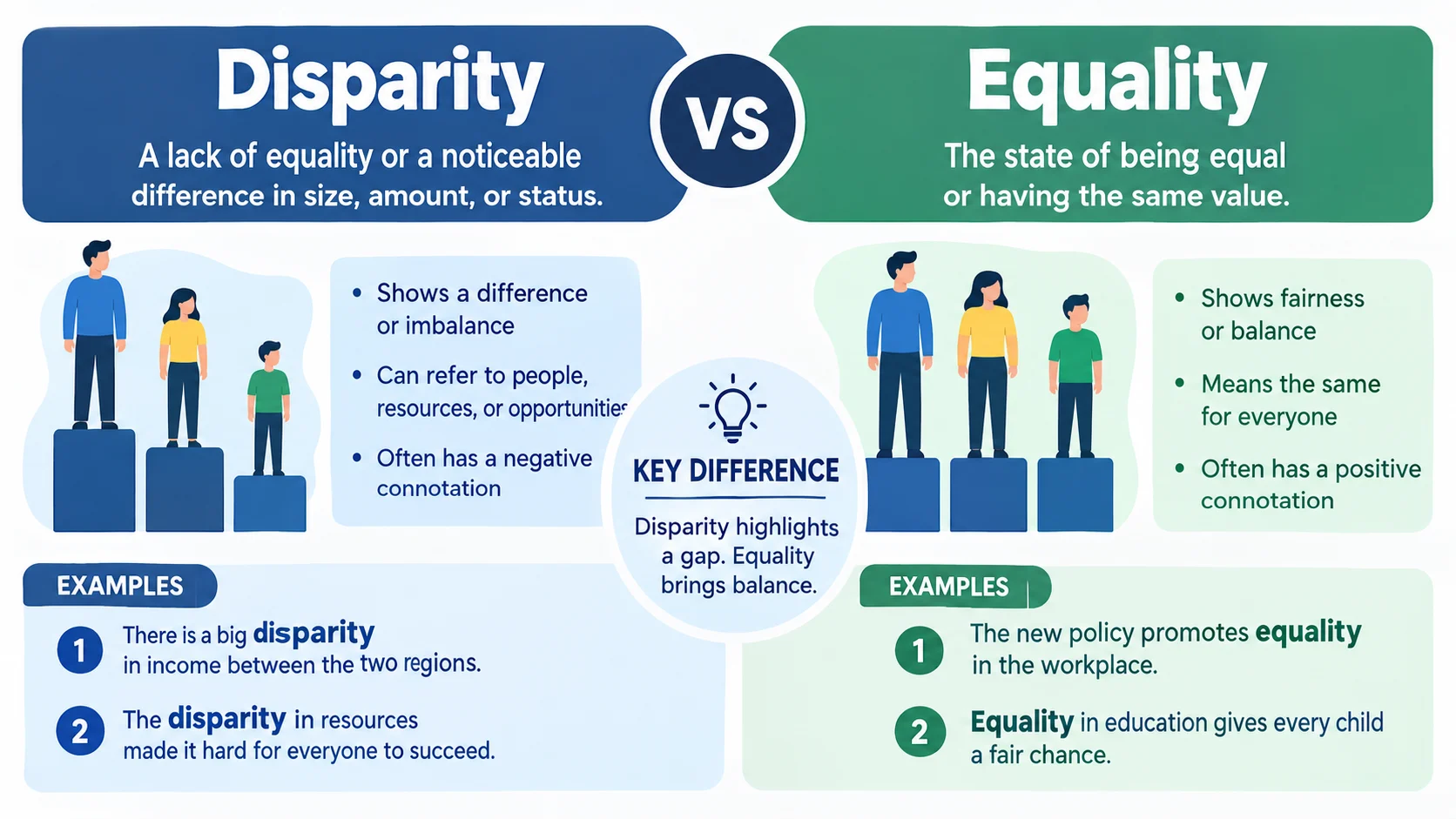
The strongest opposite of disparity is equality. Disparity refers to a noticeable difference, imbalance, or lack of equivalence between people, groups, amounts, or conditions. Depending on the context, parity, uniformity, and equivalence may also function as antonyms when the focus is on balance, sameness, or equal status.
Direct and Strong Antonyms
| Antonym | Tone or Nuance | Example Sentence |
|---|---|---|
| Equality | Most direct and common opposite | The policy was designed to promote equality among employees. |
| Parity | Emphasizes equivalent status or level | The company achieved pay parity between departments. |
| Equivalence | Focuses on equal value or effect | The two certifications were considered equivalent. |
| Uniformity | Highlights sameness or consistency | Uniformity in standards improved quality control. |
| Balance | Stresses stability and proportionality | Better balance reduced disparities in workload. |
These words work as antonyms because they describe conditions where significant differences are absent or minimized.
Contextual and Subtle Opposites
The best opposite of disparity can change depending on what kind of difference is being discussed.
When Disparity Means Inequality
Best Opposite: Equality
Why It Fits: Equality directly addresses unequal treatment, rights, opportunities, or outcomes.
Example:
- Researchers found a disparity in educational opportunities.
- Community leaders worked toward greater equality in education.
When Disparity Means a Gap Between Levels
Best Opposite: Parity
Why It Fits: Parity focuses on being at the same level, rank, or standard.
Example:
- There was a disparity in salaries between similar positions.
- The organization introduced measures to achieve salary parity.
When Disparity Means Lack of Correspondence
Best Opposite: Equivalence
Why It Fits: Equivalence emphasizes equal meaning, value, or effect.
Example:
- The committee noted a disparity between the two assessments.
- Further review confirmed their equivalence.
When Disparity Means Inconsistency
Best Opposite: Uniformity
Why It Fits: Uniformity highlights consistency and sameness across a group.
Example:
- Customers complained about disparities in service quality.
- New training standards improved uniformity across locations.
Context Summary
| Context | Best Opposite | Why It Fits |
|---|---|---|
| Social inequality | Equality | Removes unequal treatment or opportunity |
| Uneven levels | Parity | Indicates equal standing |
| Unequal value | Equivalence | Shows equal worth or effect |
| Inconsistent standards | Uniformity | Creates consistency |
| Imbalance | Balance | Restores proportionality |
Words That Seem Opposite But Are Not
Some words are often mistaken for antonyms of disparity even though they do not express a true semantic opposite.
Difference
At first glance, difference may seem related to disparity. However, disparity is actually a type of difference, usually one that is substantial or problematic.
Example:
- The difference between the two products is small.
- The disparity in price is significant.
Because disparity already implies difference, difference cannot function as its opposite.
Diversity
People sometimes confuse diversity with disparity because both involve variation among people or things.
However, diversity refers to variety or representation, while disparity refers to inequality or imbalance.
Example:
- The company values diversity in its workforce.
- The company is trying to reduce disparities in promotion rates.
A workplace can be highly diverse while still experiencing disparities.
Common Grammatical or Semantic Confusions
Equality vs Parity
These words are closely related but not identical.
Equality is broader and often refers to rights, treatment, opportunities, or status.
Parity usually refers to equivalence in measurable conditions such as pay, performance, or ranking.
Example:
- The organization supports equality in hiring.
- The organization reached pay parity across departments.
Uniformity vs Equality
Uniformity means everything is the same. Equality means everything is treated fairly or holds equal value.
Example:
- Students can receive equal opportunities without wearing identical clothes.
- A dress code creates uniformity, not necessarily equality.
This distinction matters because equal treatment does not always require complete sameness.
Frequently Asked Questions
What is the direct antonym of disparity?
The most direct antonym of disparity is equality. Disparity refers to a meaningful difference or imbalance, while equality describes a condition in which people, groups, or things share the same status, value, rights, or opportunities.
Is parity the opposite of disparity?
Yes, in many contexts. Parity is often the best opposite when discussing equal levels, standards, performance, or compensation. However, equality is generally broader and more commonly used as the primary antonym.
Which antonym should I use in formal writing?
Choose the antonym that matches your meaning. Use equality for social or legal contexts, parity for measurable comparisons, equivalence for value or effect, and uniformity for consistency across a group or system.
Final Thoughts
The strongest antonym for disparity is usually equality because it directly opposes the idea of a significant difference or inequality. In many everyday and professional contexts, equality provides the clearest and most accurate contrast.
That said, context matters. When the focus is on equal levels, parity may be more precise. When discussing equal value, equivalence can be a better choice. For consistency across a system, uniformity may fit best.
Choosing the right antonym improves clarity and helps readers understand exactly what kind of contrast you intend. What example of disparity and equality have you encountered in everyday life?
