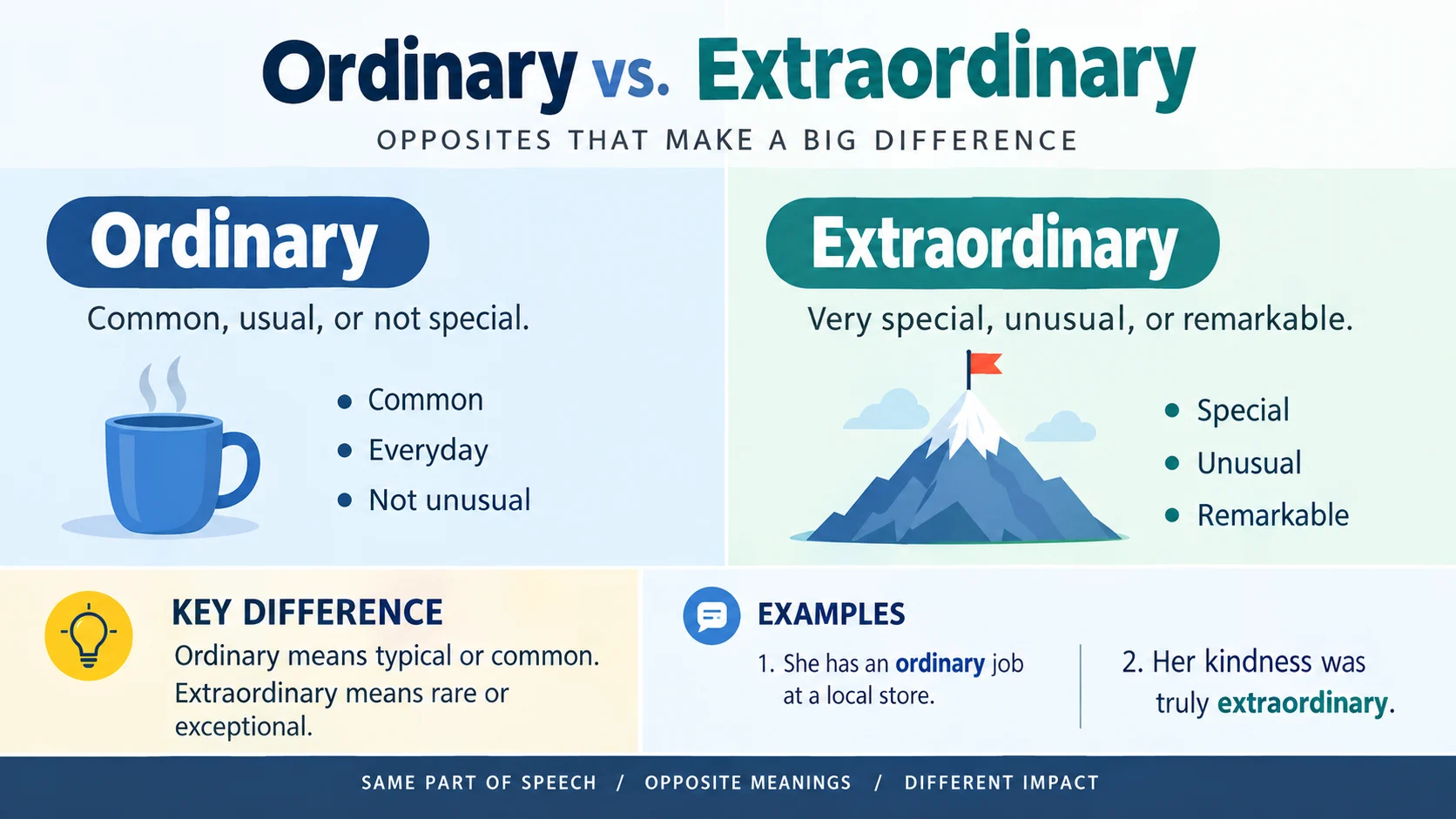
The strongest opposite of ordinary is extraordinary, meaning unusually special, remarkable, or far beyond what is typical. Ordinary means common, usual, or not distinctive. Depending on context, unusual or exceptional can also express an opposite idea, but they carry different shades of meaning and should not always be treated as exact substitutes.
Direct and Strong Antonyms
| Antonym | Tone or Nuance | Example Sentence |
|---|---|---|
| Extraordinary | Strong, emphatic, often positive | Her extraordinary talent became clear during the final performance. |
| Unusual | Neutral and factual; simply not common or typical | It was unusual to see the restaurant so empty on a Friday night. |
| Exceptional | Strong and often positive; notably better or different | His exceptional attention to detail helped prevent costly mistakes. |
Extraordinary is the clearest direct antonym when ordinary means common, normal, or unremarkable. It suggests that something stands noticeably outside the usual range.
Unusual is a more neutral contrast. Something unusual does not conform to what normally happens, but it is not necessarily better or more impressive. An unusual weather pattern, for instance, may simply be different from what people expect.
Exceptional emphasizes distinction or superiority more strongly than unusual. An exceptional student is not merely uncommon. The word usually suggests unusually high ability, quality, or achievement.
These words are related, but they are not interchangeable in every sentence.
Contextual and Subtle Opposites
The best opposite of ordinary depends on what the speaker wants to contrast.
| Context | Best Opposite | Why It Fits |
|---|---|---|
| Common or typical | Extraordinary | Directly contrasts with something far beyond the normal range. |
| Not common | Unusual | Focuses on rarity or difference rather than quality. |
| Noteworthy or unremarkable | Remarkable | Emphasizes that something deserves attention. |
| Normal ability versus unusually high ability | Exceptional | Highlights unusually strong performance or quality. |
Consider the sentence, “She has an ordinary voice.” If the intended meaning is that her voice is typical and does not stand out, extraordinary provides a strong contrast: “She has an extraordinary voice.”
However, if the meaning is simply that her voice is not common, unusual may be the more precise opposite in a different sentence. “She has an unusual voice” focuses on difference rather than excellence.
Tone also matters. Extraordinary often sounds complimentary when applied to people, abilities, experiences, or achievements. Unusual is more neutral. Exceptional usually carries positive approval, especially in professional, academic, or performance contexts.
Words That Seem Opposite But Are Not
Special
Special contrasts with ordinary in many everyday situations, but it is not always a direct antonym. It can describe something important because of personal meaning rather than rarity or exceptional quality.
For example, “This photo is special to me” does not necessarily mean the photo is extraordinary. Its importance comes from its emotional or personal significance.
Rare
Rare is another related contrast, but it focuses specifically on frequency. Something can be rare without being extraordinary, and something extraordinary does not have to be rare in every context.
For example, a rare medical condition is uncommon, but the word does not automatically communicate that the condition is remarkable or exceptional.
Common Grammatical or Semantic Confusions
One common confusion is treating unusual and extraordinary as exact equivalents. They overlap because both can contrast with ordinary, but their strength differs. “An unusual design” simply means the design is not typical. “An extraordinary design” makes a much stronger claim about its distinctive or remarkable qualities.
Another confusion involves exceptional. It can describe something that is unusually good, but ordinary can simply mean typical without making a judgment about quality. Saying that a routine office meeting was ordinary does not necessarily imply that it was bad. Calling the same meeting exceptional suggests that something about it was notably impressive.
Subtle Tone Differences
Choosing among these antonyms changes the force of a sentence.
Unusual is useful when you want to describe difference without praise or criticism:
The customer made an unusual request.
Extraordinary adds emphasis and often admiration:
The customer showed extraordinary patience throughout the delay.
Exceptional is especially useful when evaluating quality, skill, or performance:
The new employee demonstrated exceptional problem-solving skills.
In professional and academic writing, these distinctions help prevent overstatement. If something is merely different from the norm, unusual may be more accurate than extraordinary. If something clearly stands out because of quality or achievement, exceptional may communicate that idea more precisely.
Frequently Asked Questions
What is the direct antonym of ordinary?
The strongest direct antonym of ordinary is extraordinary when ordinary means common, typical, or unremarkable. Extraordinary describes something unusually special, remarkable, or far beyond what is normally expected.
Is unusual the opposite of ordinary?
Yes, unusual can function as a contextual antonym of ordinary when ordinary means typical or commonly encountered. However, unusual is neutral, while extraordinary is stronger and often suggests something notably impressive.
What should I use instead of ordinary in formal writing?
Choose the opposite based on your intended meaning. Use unusual for something that differs from the norm, exceptional for unusually high quality or ability, and extraordinary for something especially remarkable or far beyond the ordinary.
Conclusion
Extraordinary is the strongest general opposite of ordinary when the intended contrast is between something typical and something remarkably beyond the norm. Unusual and exceptional can also work, but they emphasize different aspects of that contrast.
The most precise choice depends on context. If you only mean that something differs from what is common, unusual may be enough. If you want to emphasize remarkable quality or achievement, extraordinary or exceptional may communicate the idea more effectively.
