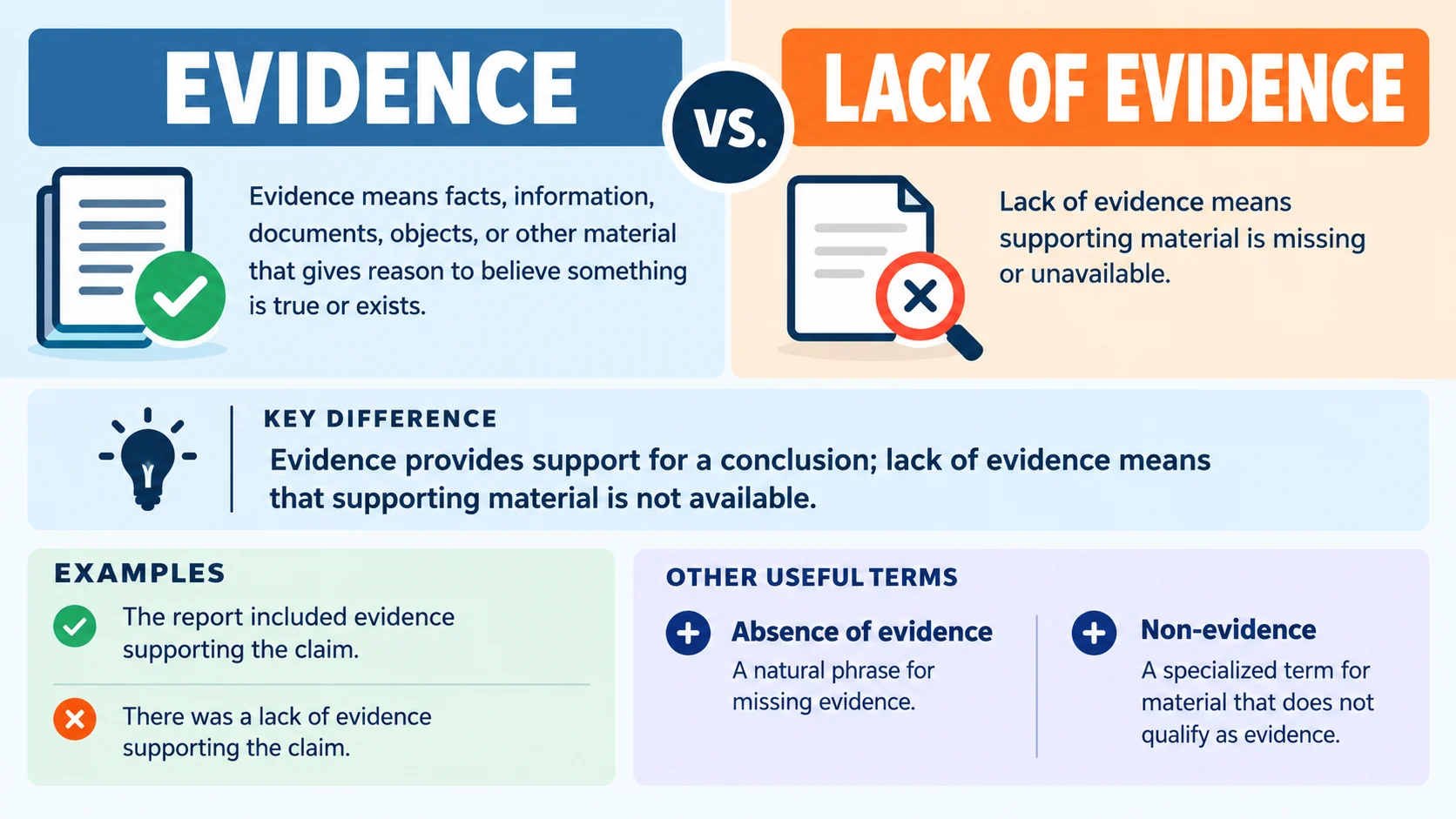
The strongest opposite of evidence is usually lack of evidence or absence of evidence. Evidence means facts, information, documents, objects, or other material that supports a conclusion. Because English has no single perfect lexical antonym for evidence, the best choice depends on whether the focus is missing support or material that does not qualify as evidence.
Direct and Strong Antonyms
| Term | Type | Meaning / Nuance | Example |
|---|---|---|---|
| Lack of evidence | Primary contextual opposite | Supporting facts or information are missing or unavailable | “There was a lack of evidence supporting the claim.” |
| Absence of evidence | Primary contextual opposite | Evidence is not present or has not been found | “The absence of evidence made the conclusion difficult to support.” |
| Non-evidence | Specialized contextual opposite | Material that does not qualify as evidence | “The reviewer separated documented evidence from non-evidence.” |
| Speculation | Related contrast | An idea or interpretation that goes beyond what available evidence establishes | “The explanation was speculation rather than a documented finding.” |
| Disproof | Not an antonym | Evidence or reasoning that demonstrates a claim is false | “The new test provided disproof of the original theory.” |
| Falsehood | Not an antonym | A statement or belief that is untrue | “The evidence showed that the statement was a falsehood.” |
Evidence does not behave like a simple gradable adjective with one neat opposite. In American English, the most natural opposite is often expressed as a phrase rather than a single word.
Absence of evidence
Tone or nuance: Neutral, precise, and common in formal and analytical writing.
Example: “The investigators found an absence of evidence linking the two incidents.”
Lack of evidence
Tone or nuance: Natural, direct, and especially common in everyday, professional, legal, and academic contexts.
Example: “The committee declined to act because of a lack of evidence supporting the claim.”
Non-evidence
Tone or nuance: Specialized and less common. It can refer to something that does not constitute evidence, rather than simply saying that evidence is missing.
Example: “A personal impression is not necessarily evidence, and the report carefully separates non-evidence from documented findings.”
Of these choices, “lack of evidence” is often the most natural wording when you mean that supporting facts or material are not available. “Absence of evidence” is useful when emphasizing that evidence is not present. Cambridge explicitly records “absence of evidence” as a common collocation and also lists “non-evidence” among terms related to proving and disproving. (Cambridge Dictionary)
Contextual and Subtle Opposites
The best opposite changes slightly depending on what you want to communicate.
Context: No supporting material exists or has been found
Best opposite: lack of evidence
Why it fits: This focuses on insufficient or unavailable facts, documents, observations, or other support.
Example: “There is a lack of evidence that the product caused the problem.”
Context: Evidence is specifically not present
Best opposite: absence of evidence
Why it fits: This phrasing highlights the state of having no evidence rather than the process of failing to find enough support.
Example: “The absence of evidence made it difficult to determine what happened.”
Context: A statement has no evidentiary status
Best opposite: non-evidence
Why it fits: This specialized term distinguishes material that does not count as evidence from evidence itself.
Example: “The analyst removed several unsupported assumptions from the evidence review because they were treated as non-evidence.”
Context: A claim is based on guessing rather than support
Best opposite: speculation
Why it fits: “Speculation” is a contextual contrast, not a strict antonym. It describes ideas or conclusions that go beyond what the available evidence establishes.
Example: “The article separates documented findings from speculation about what might happen next.”
Words That Seem Opposite But Are Not
Disproof is not the opposite of evidence. Disproof is evidence or reasoning that shows a claim is false. In other words, disproof can itself be evidence. For example, “The new test provided disproof of the original theory” describes a kind of evidence against the theory, not an absence of evidence.
Falsehood is also not a direct antonym. Evidence can support a true or false proposition, and falsehood describes a statement or belief that is untrue. The relationship is about what evidence shows, not about evidence versus its opposite.
Another common confusion is proof. Proof is closely related to evidence, not opposite to it. Evidence provides support for a conclusion, while proof can refer to evidence or reasoning that establishes something with a high degree of certainty in a particular context. The two terms should not be treated as semantic opposites.
Subtle Tone Differences
“Lack of evidence” is usually the safest choice for clear general writing. It sounds natural in sentences such as, “There is a lack of evidence to support the allegation.”
“Absence of evidence” is somewhat more formal and analytical. It can emphasize the condition itself: “The absence of evidence prevented the researchers from drawing a firm conclusion.”
“Non-evidence” is more technical. Use it when you specifically need to distinguish something that does not qualify as evidence. It is not simply a more formal replacement for “lack of evidence.”
“Speculation” shifts the focus from missing evidence to unsupported interpretation. Compare: “There is a lack of evidence for the claim” with “The explanation is speculation.” The first says supporting evidence is missing. The second characterizes the explanation as an unsupported interpretation.
Frequently Asked Questions
What is the direct antonym of evidence?
There is no single perfect direct antonym for the noun evidence in common American English. “Lack of evidence” and “absence of evidence” are the clearest opposites when evidence means facts or information that support a conclusion. “Non-evidence” is a more specialized contrast.
What is the opposite of evidence in a legal or academic context?
In legal and academic writing, “lack of evidence” is usually the clearest choice when supporting material has not been found or presented. “Absence of evidence” can emphasize that evidence is not present. The appropriate phrase depends on the exact point being made.
Is speculation the opposite of evidence?
No. Speculation is a contextual contrast, not an exact antonym of evidence. Evidence provides support for a conclusion, while speculation involves an idea or interpretation that goes beyond what the available evidence establishes. A sentence can accurately contrast evidence with speculation without treating them as true lexical opposites.
Conclusion
The clearest opposite of evidence is usually not a single word. “Lack of evidence” and “absence of evidence” naturally express the idea that supporting facts, information, documents, or observations are missing. The choice between them mainly depends on emphasis and tone.
Context also matters because related terms can describe different relationships to evidence. Speculation contrasts with evidence in some discussions, while disproof can actually be a form of evidence. Choosing the precise expression keeps your writing accurate and avoids forcing a weak antonym.
When you need an opposite for evidence, first ask whether you mean missing support, material that does not qualify as evidence, or an unsupported interpretation. Which example best matches the context you are writing about?
