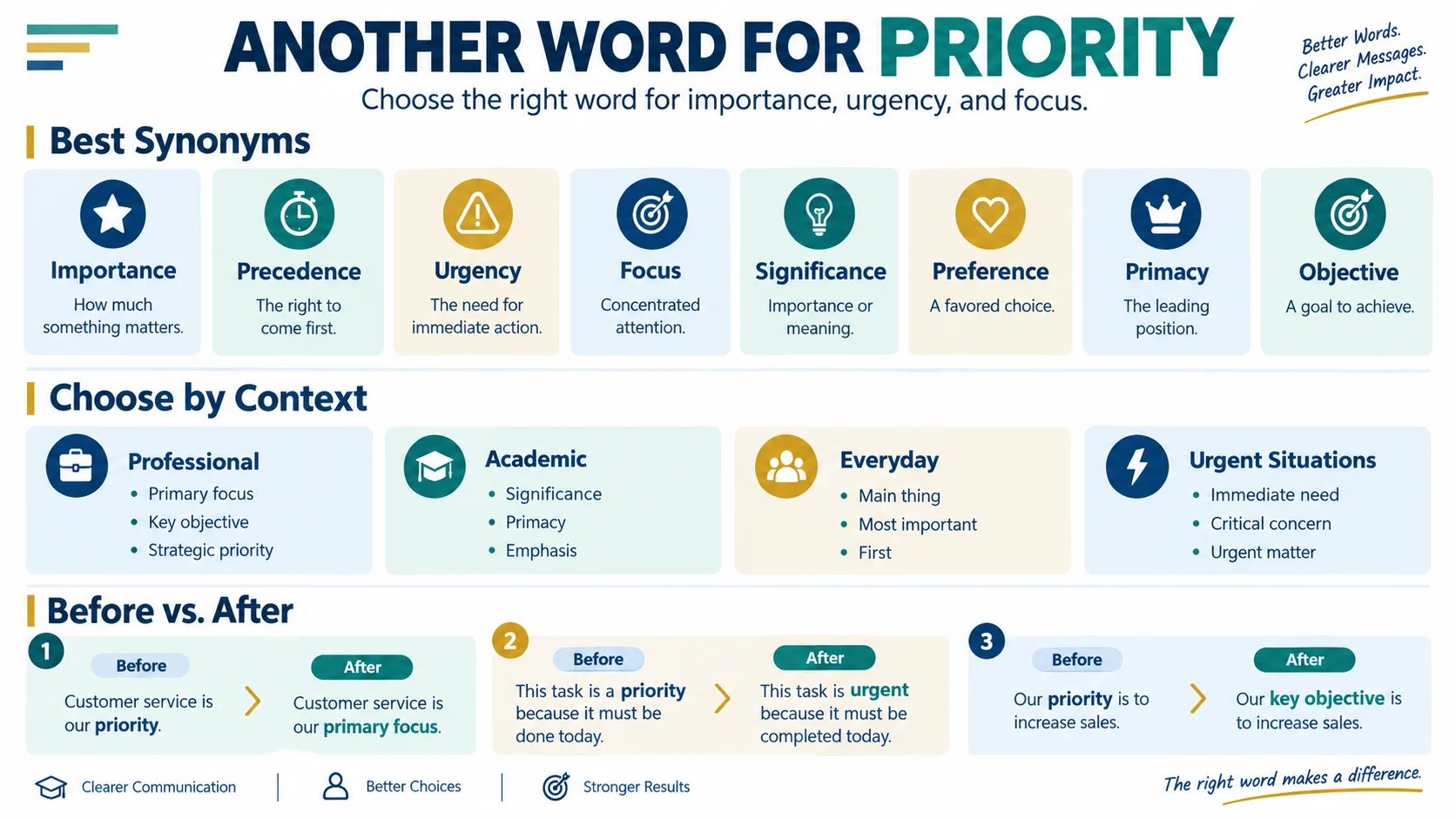
The best alternative to priority depends on your meaning. Use precedence when something should come first, importance when it matters most, urgency when it requires immediate attention, and preference when expressing a choice. In professional writing, top concern, key objective, and primary focus are also useful alternatives.
What Does Priority Mean?
Definition
Priority is the status given to something that deserves attention, action, or consideration before other things. It can refer to importance, order, urgency, or a preference among competing choices.
For example, a manager might make customer satisfaction a priority, a student might prioritize an upcoming exam, and a doctor might treat a critical patient first.
Although these situations share the idea of putting something first, they do not have exactly the same meaning. Choosing the right synonym depends on whether you want to emphasize importance, timing, order, or personal choice.
Common Uses
The word priority appears in several everyday and professional contexts:
- Importance: Safety is our highest priority.
- Urgency: This request has priority because it must be completed today.
- Order: Emergency cases receive priority over routine appointments.
- Personal preference: Spending time with family is a priority for her.
- Business planning: Increasing customer retention is a strategic priority.
Understanding these differences helps you choose a replacement that communicates your intended meaning without changing the message.
Best Synonyms for Priority
The following words are useful alternatives to priority, but each emphasizes a slightly different idea.
| Synonym | Meaning | Best Used When | Example |
|---|---|---|---|
| Importance | The quality of being significant | Explaining value or significance | Customer satisfaction is of great importance. |
| Precedence | The right to come before something else | Establishing order or preference | Safety takes precedence over speed. |
| Urgency | The need for immediate action | Describing time-sensitive matters | The repair has considerable urgency. |
| Preference | A choice or favored option | Expressing personal or organizational choices | Quality is our preference when selecting suppliers. |
| Primacy | The state of being first or most important | Formal or academic writing | The study emphasizes the primacy of prevention. |
| Significance | The importance or meaning of something | Discussing impact or relevance | The findings highlight the significance of early intervention. |
| Focus | Concentrated attention on something | Describing effort or attention | Our primary focus is employee development. |
| Objective | A goal intended to be achieved | Planning and professional communication | Improving service is a key objective. |
| Concern | Something that requires attention | Identifying an important issue | Data security remains a major concern. |
| Imperative | Something essential or urgently necessary | Strong formal statements | Immediate action is an operational imperative. |
| Emphasis | Special attention or importance given to something | Highlighting a particular aspect | The training places emphasis on accuracy. |
| Preeminence | The state of being superior or foremost | Formal discussions of leading status | The organization seeks preeminence in research. |
Quick selection tip: Choose importance for significance, precedence for order, urgency for time pressure, and focus for concentrated attention. These are among the most practical alternatives in American English.
Synonyms by Context
Formal Writing
In formal writing, the best synonym depends on the argument or relationship being described.
- Precedence: Best when one responsibility, rule, or consideration must come before another.
- Primacy: Suitable for emphasizing the leading position of a principle or concept.
- Significance: Useful when explaining why an issue, finding, or event matters.
- Imperative: Appropriate when describing an essential requirement or compelling need.
Example: “The primacy of public safety must guide infrastructure planning.”
This wording sounds more formal than “Public safety is the top priority.” However, primacy emphasizes a leading position, while imperative suggests necessity rather than simply importance.
Professional Writing
Business communication often benefits from direct, specific language.
Consider these alternatives:
- Primary focus: For the main area receiving attention.
- Key objective: For a goal that supports a business plan.
- Top concern: For an issue requiring particular attention.
- Strategic priority: For an important organizational initiative.
- Main responsibility: For a duty assigned to a person or team.
Example: “Improving client retention is our primary focus this quarter.”
This is more specific than “Client retention is our priority” because it identifies the area where the team will concentrate its efforts.
Academic Writing
Academic writing requires precision. Select a word that reflects the relationship you are describing rather than replacing priority automatically.
- Significance: For the importance of a finding or issue.
- Primacy: For the leading status of a theory, principle, or factor.
- Emphasis: For the attention a paper or study gives a topic.
- Precedence: For an established order of importance.
- Research objective: For a goal of an investigation.
Example: “The study emphasizes the significance of early literacy interventions.”
Use research objective when you mean a planned research goal, not merely an important topic. A priority and an objective are related, but they are not interchangeable in every sentence.
Daily Conversation
In everyday American English, simple alternatives often sound more natural than formal vocabulary.
Try:
- Main thing: “Finishing my assignment is the main thing today.”
- Most important: “Getting enough sleep is most important.”
- Top concern: “Your safety is my top concern.”
- Focus: “Let’s focus on the next step.”
- First thing: “Paying the bills is the first thing I need to do.”
These expressions are easy to understand and work well in casual conversations, messages, and straightforward emails.
Professional Alternatives for Priority
If you are writing a business email, project update, presentation, or résumé, consider these alternatives:
| Alternative | Best Application | Example |
|---|---|---|
| Primary focus | Business plans and team updates | Quality control is our primary focus. |
| Key objective | Project goals | Reducing response times is a key objective. |
| Strategic priority | Executive communication | Digital accessibility is a strategic priority. |
| Critical concern | Risk management | System reliability is a critical concern. |
| Top initiative | Organizational projects | Employee training is a top initiative this year. |
| Core responsibility | Job duties | Client communication is a core responsibility. |
| Immediate need | Time-sensitive tasks | Replacing the damaged equipment is an immediate need. |
For résumés, avoid merely stating that something was a priority. Explain what you accomplished.
Instead of “Customer service was my priority,” write: “Improved customer satisfaction by resolving service issues promptly.”
The revised statement demonstrates an action and an outcome. Use measurable results only when they accurately reflect your experience.
Simple Alternatives for Priority
When clarity matters more than formality, these words and phrases are easy replacements:
- Importance: “Education is important to our community.”
- Main thing: “The main thing is finishing the project.”
- First: “Handle the safety checks first.”
- Focus: “Our focus is helping new customers.”
- Preference: “My preference is to review the report today.”
- Top concern: “Accuracy is our top concern.”
A simple alternative can make a sentence clearer, but check the meaning before making the substitution. For example, first describes order, while important describes significance.
Stronger Alternatives for Priority
Sometimes, priority does not convey enough weight. These alternatives communicate greater importance, necessity, or urgency.
Critical concern: Use this when a matter could cause serious problems if neglected.
Example: “Protecting confidential customer information is a critical concern.”
Imperative: Use this when something is essential or demands action.
Example: “It is imperative that the team verify the figures before publication.”
Nonnegotiable requirement: Use this when a condition must be met.
Example: “Compliance with safety regulations is a nonnegotiable requirement.”
Urgent matter: Use this when time is the central issue.
Example: “The server outage is an urgent matter that requires immediate attention.”
Paramount consideration: Use this in formal writing when something ranks above other considerations.
Example: “Patient safety remains the paramount consideration.”
These expressions are stronger than ordinary alternatives, so reserve them for situations that genuinely justify their intensity.
Difference Between Similar Synonyms
Several words related to priority are easy to confuse. Their distinctions matter in polished writing.
| Word | Main Difference | Example |
|---|---|---|
| Priority | Something given special importance or earlier attention | Completing the report is a priority. |
| Importance | The degree to which something matters | The importance of the report is clear. |
| Precedence | The order in which something comes before something else | Safety takes precedence over convenience. |
| Urgency | The need to act quickly | The request has urgency because the deadline is today. |
| Preference | A favored choice | I have a preference for the earlier meeting. |
| Objective | A result someone intends to achieve | Our objective is to improve response times. |
| Focus | The subject receiving concentrated attention | Our focus is improving customer service. |
| Emphasis | Special attention given to a point or feature | The presentation places emphasis on reliability. |
The most important distinction is that priority can combine importance and order, whereas urgency specifically concerns time pressure. A task can be important without being urgent, and something urgent may not be strategically important.
Likewise, a preference reflects a favored choice, while an objective identifies a goal.
Opposite Words
The opposite of priority depends on the intended meaning. There is no single antonym that fits every use.
Common opposites and contrasting expressions include:
- Low priority: Something that deserves less immediate attention.
- Unimportance: A lack of significance.
- Neglect: Failure to give appropriate attention.
- Secondary concern: An issue considered less important than another.
- Inferior position: A lower rank or status in a hierarchy.
- Last place: The final position in an order.
Example: “Routine maintenance is a low priority while the emergency repairs are underway.”
Here, low priority is more natural than unimportance because maintenance still matters; it simply receives less immediate attention.
FAQs
What is another word for priority?
Common alternatives include importance, precedence, urgency, focus, preference, and significance. The best choice depends on whether you mean importance, order, time pressure, or a favored choice.
What is a formal synonym for priority?
Precedence and primacy are useful formal synonyms when discussing order or leading importance. Significance works when you mean the importance of an issue or finding.
What is a professional alternative for priority?
Use primary focus, key objective, strategic priority, top concern, or core responsibility, depending on the sentence. For a business goal, key objective is often more precise.
What word can replace priority in a résumé?
Consider focus, objective, responsibility, or initiative. Choose the word that accurately describes your contribution, and strengthen the statement with a genuine achievement when possible.
Is urgency the same as priority?
No. Urgency means that something requires prompt attention. Priority means that something receives special importance or is handled before other matters. A task can be important without requiring immediate action.
What is the difference between priority and precedence?
Priority describes the importance or preferred treatment of something. Precedence specifically emphasizes coming before something else in order, authority, or consideration.
What is the best synonym for priority in business writing?
Primary focus is a good general choice when describing where a team directs its effort. Key objective is better for a measurable goal, while strategic priority suits an important organizational initiative.
What is a simple word for priority?
Importance, focus, and first are simple alternatives in many sentences. For example, “Safety comes first” communicates the idea naturally.
Conclusion
The best synonym for priority is the one that preserves your intended meaning. Choose importance for significance, precedence for order, urgency for immediate action, focus for concentrated effort, and objective for a goal.
For professional communication, primary focus and key objective are often clear, natural choices. In academic or formal writing, primacy, precedence, and significance may be more appropriate. Always consider the context, tone, and intended meaning before replacing the original word.
