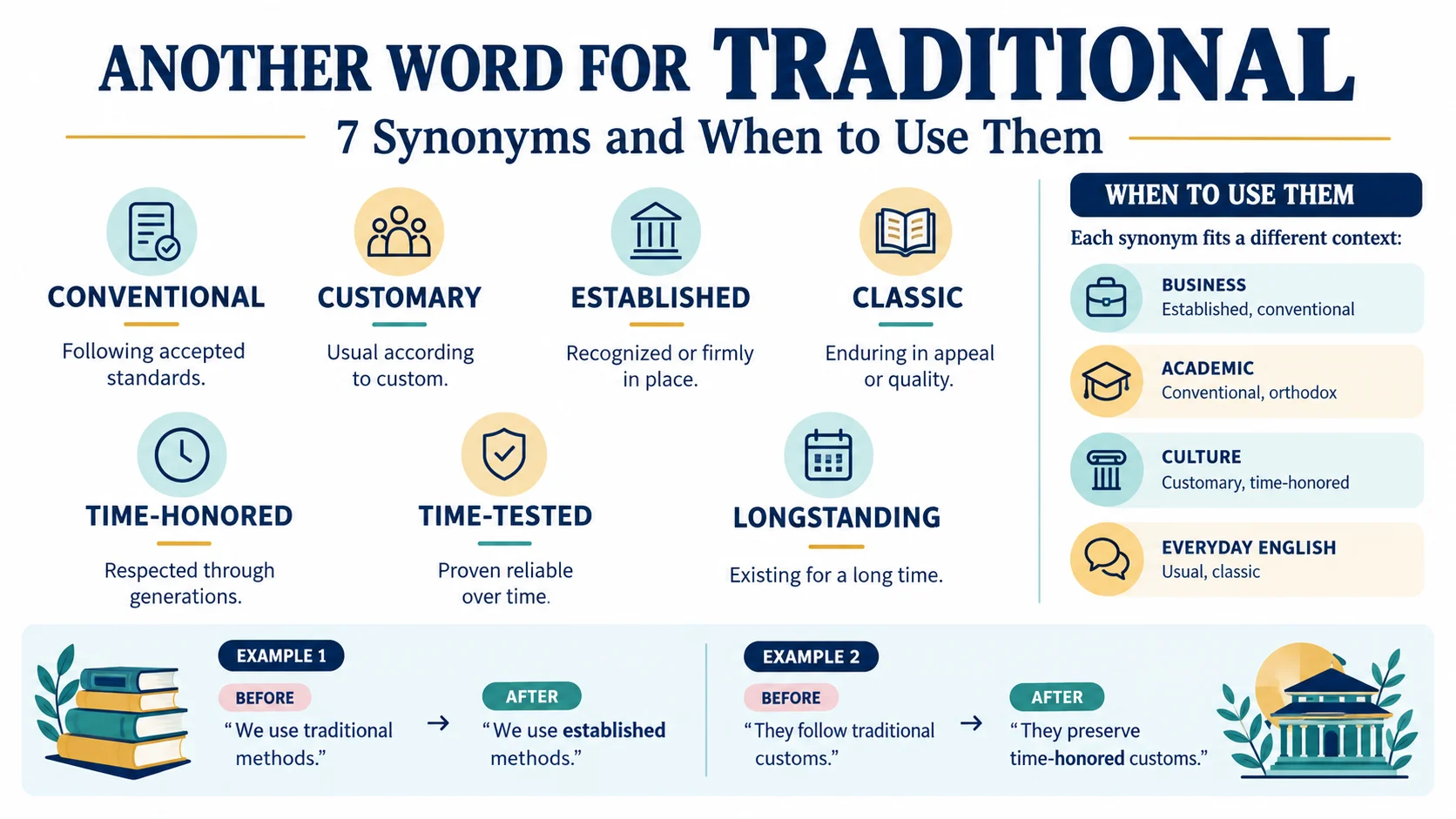
Another word for traditional is conventional, customary, established, classic, time-honored, or longstanding. The best synonym depends on the context. Use conventional for widely accepted practices, customary for usual behavior, classic for enduring quality, and time-honored to emphasize respect for long-standing customs.
What Does Traditional Mean?
Definition
Traditional is an adjective that describes beliefs, customs, practices, methods, or styles that have been passed down through generations or maintained over time. It can also refer to something that follows established conventions rather than introducing new or unconventional approaches.
For example, a traditional wedding may include customs inherited from previous generations, while traditional teaching may rely on familiar classroom methods.
Traditional does not always mean old-fashioned. The word can express cultural pride, reliability, continuity, or respect for established practices. Its meaning depends on the subject and the speaker’s intention.
Common Uses
The word traditional commonly appears in these contexts:
- Culture and family: traditional celebrations, family customs, cultural clothing.
- Business: traditional marketing, conventional business models, established procedures.
- Education: traditional classrooms, conventional teaching methods.
- Food and design: traditional recipes, classic furniture, heritage-inspired interiors.
- Writing and communication: traditional approaches, customary expressions, established formats.
Understanding the context helps you select a more precise replacement instead of using the same synonym everywhere.
Best Synonyms for Traditional
The following alternatives cover the most useful meanings of traditional, from familiar practices to heritage, formality, and established standards.
| Synonym | Meaning | Best Used When | Example |
|---|---|---|---|
| Conventional | Following accepted standards | Common practices or methods | The company uses conventional marketing. |
| Customary | Usual or based on custom | Repeated social practices | It is customary to greet guests. |
| Established | Recognized or firmly in place | Procedures and institutions | We followed established guidelines. |
| Classic | Enduring in appeal or quality | Design, style, and literature | She chose a classic design. |
| Time-honored | Respected because of long use | Heritage and valued customs | They preserved a time-honored ritual. |
| Longstanding | Existing for a long time | Relationships and practices | The firm has a longstanding policy. |
| Conventionalized | Made to follow a convention | Specialized artistic or technical contexts | The symbol uses a conventionalized form. |
| Heritage-based | Rooted in inherited culture or history | Cultural projects and products | The restaurant serves heritage-based dishes. |
| Ancestral | Connected with one’s ancestors | Family and cultural heritage | They visited their ancestral village. |
| customary | Established through repeated practice | Social or community expectations | It is customary to exchange gifts. |
| Orthodox | Conforming to accepted beliefs or doctrine | Religious or ideological contexts | The group follows orthodox teachings. |
| Standard | Commonly accepted as a benchmark | Procedures and specifications | The team used a standard format. |
| Mainstream | Widely accepted or practiced | Popular ideas and methods | The company adopted a mainstream strategy. |
| Old-fashioned | Belonging to an earlier style or period | Informal or critical descriptions | His approach seemed old-fashioned. |
| Time-tested | Proven reliable over time | Methods and solutions | This is a time-tested technique. |
Word choice tip: Conventional, customary, and established are often useful general alternatives. Choose ancestral or time-honored when heritage matters, and classic when lasting appeal is the focus.
Synonyms for Traditional by Context
The most effective synonym depends on what you are describing. A word that works for a cultural custom may sound unnatural in a business report, so consider the intended meaning and tone.
Formal Writing
Use precise, established vocabulary in reports, formal correspondence, and professional documents.
- Established: Appropriate for recognized procedures, policies, and institutions.
- Customary: Best for accepted social practices and expected behavior.
- Orthodox: Suitable for established doctrines, beliefs, or schools of thought.
- Conventional: Useful when describing accepted standards or traditional approaches.
Example: “The researchers compared conventional methods with newer alternatives.”
Professional Writing
In business communication, choose words that explain whether a process is proven, widely accepted, or maintained over time.
- Established: “We followed established quality-control procedures.”
- Time-tested: “The team applied a time-tested approach to customer service.”
- Standard: “All departments use a standard reporting format.”
- Longstanding: “The company maintains a longstanding relationship with its suppliers.”
These alternatives are particularly useful in business reports, proposals, presentations, and workplace emails.
Academic Writing
Academic writing benefits from words that communicate the specific relationship between an idea and its history.
- Conventional: For widely accepted methods or interpretations.
- Historically established: For practices supported by historical development.
- Orthodox: For accepted theoretical or doctrinal positions.
- Customary: For practices regularly observed in a particular community.
Example: “The study evaluates conventional approaches to language instruction and considers alternative teaching models.”
Avoid replacing traditional with historic automatically. Historic usually emphasizes historical importance, while traditional emphasizes inherited customs or established practices.
Daily Conversation
In everyday English, simple words often sound more natural than formal alternatives.
- Usual: “We took our usual route home.”
- Classic: “That is a classic family recipe.”
- Old-fashioned: “My grandfather prefers old-fashioned manners.”
- Customary: “It is customary to bring a small gift.”
Use old-fashioned carefully because it can suggest that something is outdated rather than simply inherited or familiar.
Professional Alternatives for Traditional
If you are writing a resume, email, report, or business proposal, choose the replacement that conveys the intended benefit.
| Original phrase | Better alternative | Example |
|---|---|---|
| Traditional methods | Established methods | We improved established methods to reduce errors. |
| Traditional approach | Proven approach | We applied a proven approach to project planning. |
| Traditional process | Standard process | The team documented the standard process. |
| Traditional business model | Conventional business model | The company reassessed its conventional business model. |
| Traditional practices | Longstanding practices | The department reviewed longstanding practices. |
| Traditional strategy | Time-tested strategy | The team evaluated a time-tested strategy. |
For resumes, avoid describing your work as merely traditional if you want to emphasize achievement. Instead, identify the relevant skill or outcome.
For example:
- Less specific: “Used traditional marketing techniques.”
- More specific: “Implemented established marketing methods to strengthen customer engagement.”
Only claim measurable results when you can substantiate them.
Simple Alternatives for Traditional
For readers who want familiar, easy-to-understand vocabulary, these alternatives are usually straightforward:
| Word | Meaning | Example |
|---|---|---|
| Usual | What normally happens | We followed our usual routine. |
| Old | Existing for a long time | The family kept its old recipes. |
| Common | Found or practiced frequently | This is a common approach. |
| Standard | Accepted as a normal requirement | Use the standard procedure. |
| Classic | Recognized for lasting appeal | She wore a classic black dress. |
| Familiar | Well known through experience | The students used a familiar method. |
Not all these words are interchangeable. Common means widespread, familiar means well known, and classic often suggests lasting quality or recognition.
Stronger Alternatives for Traditional
When you want to emphasize history, continuity, or reliability, consider these more descriptive alternatives.
- Time-honored: Suggests respect for a valued practice passed down over time.
- Time-tested: Emphasizes that something has demonstrated reliability through experience.
- Long-established: Highlights a practice, institution, or method with a long history.
- Ancestral: Connects a custom, place, or belief with one’s ancestors.
- Deep-rooted: Suggests that a belief, habit, or custom is firmly embedded in a community.
- Historic: Emphasizes historical significance or association with the past.
Examples:
- “The community continues a time-honored celebration.”
- “The engineers relied on a time-tested procedure.”
- “The organization maintains a long-established policy.”
- “The family preserves its ancestral traditions.”
- “The region has a deep-rooted musical heritage.”
Choose the word that supports your message rather than simply selecting the most sophisticated-sounding option.
Difference Between Similar Synonyms
Several words overlap with traditional, but each has a distinct emphasis. Dictionary and thesaurus references also distinguish between customs inherited over generations, accepted conventions, and practices that are simply usual.
| Word | Key difference | Best example |
|---|---|---|
| Traditional | Connected with inherited customs or established practices | Traditional wedding customs |
| Conventional | Follows accepted standards or expectations | Conventional teaching methods |
| Customary | Normally done according to custom | Customary greetings |
| Classic | Has enduring appeal, recognition, or quality | A classic novel |
| Established | Recognized, accepted, or firmly in place | Established procedures |
| Orthodox | Conforms to accepted doctrine or established beliefs | Orthodox interpretations |
| Historic | Important in or associated with history | A historic agreement |
| Old-fashioned | Reflects an earlier style and may imply outdatedness | Old-fashioned attitudes |
| Time-tested | Demonstrated reliability through experience | A time-tested solution |
| Mainstream | Widely accepted or practiced by many people | Mainstream opinions |
Which synonym should you choose?
Use these quick distinctions to make the right choice:
- To describe customs inherited across generations, choose traditional or ancestral.
- To describe accepted ways of doing something, choose conventional.
- To describe a usual social practice, choose customary.
- To emphasize reliability, choose time-tested.
- To highlight lasting style or appeal, choose classic.
- To describe a recognized process, choose established.
- To suggest that something is outdated, choose old-fashioned.
Real-world examples
Business example
Original: “The business relies on traditional sales methods.”
Alternative: “The business relies on established sales methods.”
The revised sentence emphasizes that the methods are already in place without implying that they are outdated.
Academic example
Original: “Traditional teaching methods remain widely used.”
Alternative: “Conventional teaching methods remain widely used.”
The alternative focuses on accepted teaching approaches rather than their historical origins.
Daily conversation example
Original: “We prepared a traditional family meal.”
Alternative: “We prepared a classic family meal.”
The revised sentence emphasizes the meal’s familiar, enduring appeal. However, traditional family meal is more appropriate when the recipe or preparation method has been passed down through generations.
Opposite Words for Traditional
The best antonym depends on whether traditional refers to inherited customs, accepted conventions, or older styles. Common opposites include modern, contemporary, unconventional, innovative, and new.
| Antonym | Meaning | Example |
|---|---|---|
| Modern | Relating to the present or recent times | The school adopted modern teaching tools. |
| Contemporary | Existing or occurring in the present period | The gallery features contemporary art. |
| Unconventional | Different from accepted practices | She proposed an unconventional solution. |
| Innovative | Introducing new ideas or methods | The team developed an innovative strategy. |
| New | Recently created or introduced | The company tested a new process. |
| Progressive | Favoring change or improvement | The organization adopted progressive policies. |
Remember that these words are not perfect opposites in every sentence. A traditional practice can be modern in its current application, and an established method can still be innovative when used in a new context.
FAQs
What is another word for traditional?
The most common alternatives are conventional, customary, established, classic, and time-honored. Choose customary for usual practices, conventional for accepted methods, and time-honored for valued traditions passed down over time.
What is a formal synonym for traditional?
Conventional is a useful formal synonym when describing accepted methods, standards, or practices. Established works well for recognized procedures, while orthodox is appropriate for established beliefs or doctrinWhat is a professional alternative for traditional?
Professional alternatives include established, standard, proven, time-tested, and longstanding. The best choice depends on whether you want to emphasize recognition, consistency, reliability, or histoWhat word can replace traditional in an essay?
Use conventional for accepted approaches, customary for regular practices, historically established for practices with a documented history, and orthodox for accepted theoretical positions. Check that the replacement preserves your original meaning.
What is another word for traditional in a positive sense?
Time-honored, classic, heritage-based, and time-tested can convey positive associations. These words emphasize respected customs, lasting appeal, cultural heritage, or reliability.
What is a simpler word for traditional?
Usual, common, old, and standard are accessible alternatives. However, usual describes what normally happens, while standard describes an accepted level or format.
Is conventional the same as traditional?
Not exactly. Traditional often emphasizes customs or practices inherited over time. Conventional emphasizes what people generally accept or expect. A practice can be conventional without having a long history.
What is the opposite of traditional?
Common antonyms include modern, contemporary, unconventional, innovative, and new. Use unconventional when contrasting accepted practices with unusual approaches, or modern when contrasting older styles with present-day ones.
What is another word for traditional in a resume?
Consider established, standard, or time-tested, depending on the context. For stronger resume writing, describe the specific methods you used, the skills you applied, and any verifiable results you achieved.
Can traditional mean old-fashioned?
Yes, in some contexts. When describing a person or attitude, traditional can suggest a preference for long-established values or customs. However, old-fashioned more readily suggests that something belongs to an earlier period or may be outdated.
Conclusion
The best word for traditional depends on the meaning you want to communicate. Conventional works well for accepted methods, customary describes usual practices, established emphasizes recognition, classic conveys lasting appeal, and time-honored highlights valued traditions.
Before replacing the word, consider your audience, tone, and intended meaning. A precise synonym makes your writing clearer, more natural, and more effective in academic work, professional communication, and everyday conversation.
