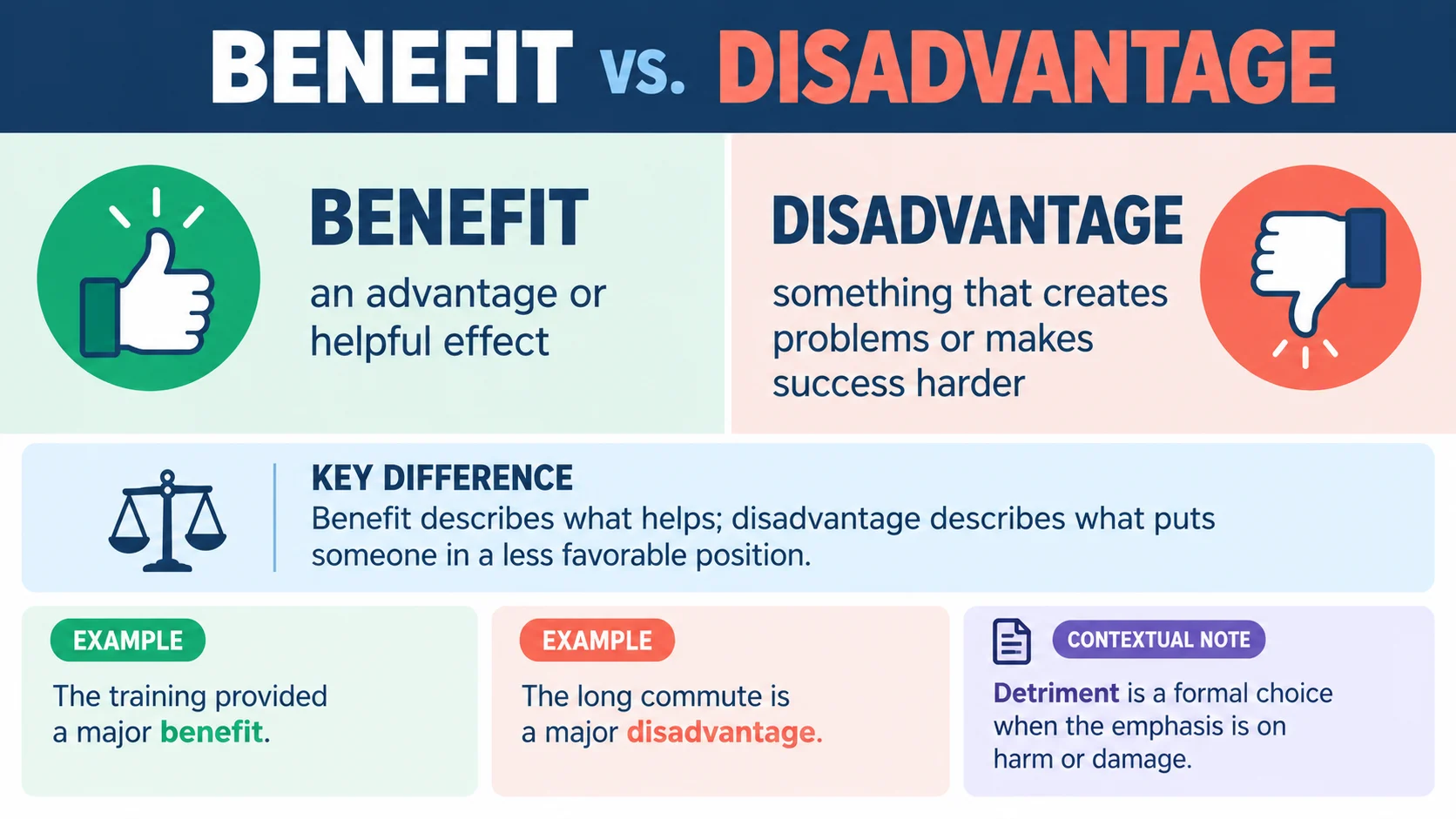
When benefit means an advantage, helpful effect, or something that improves a situation, disadvantage is its clearest direct opposite. Benefit describes something favorable or useful, while disadvantage describes something that creates difficulties or places someone in a less favorable position.
Part of speech: Noun and verb
Primary opposite: disadvantage
Direct and Strong Antonyms
Disadvantage
Tone or nuance: Neutral, common, and versatile.
Example: “The biggest disadvantage of the apartment is the long commute.”
Disadvantage is the strongest direct antonym of benefit when the word means an advantage or something that helps. It works naturally in everyday American English as well as workplace, academic, and professional writing.
Common expressions include major disadvantage, serious disadvantage, competitive disadvantage, and at a disadvantage.
For example:
“Flexible hours are a major benefit for employees.”
The contrasting statement is:
“A rigid schedule can be a major disadvantage for employees.”
The two words describe opposite sides of an evaluation: one identifies something favorable, while the other identifies something unfavorable.
Detriment
Tone or nuance: Formal and stronger, especially when emphasizing harm or damage.
Example: “The change was made to the detriment of smaller suppliers.”
Detriment can function as a contextual opposite of benefit when the focus is on harm or damage. It is more formal than disadvantage, so it should not automatically replace disadvantage in ordinary sentences.
For example, “The plan has several disadvantages” sounds neutral and straightforward. “The plan could operate to the detriment of small businesses” is more formal and emphasizes a harmful consequence.
Contextual and Subtle Opposites
The best opposite can change depending on the meaning of benefit in a particular sentence.
| Context | Best opposite | Why it fits |
|---|---|---|
| Benefit as an advantage | Disadvantage | Directly contrasts something favorable with something unfavorable. |
| Benefit as a helpful effect | Detriment | Emphasizes harm or damage rather than simply an unfavorable position. |
| Benefit as a verb meaning “help” | Disadvantage | Describes putting someone in a worse position or making success harder. |
| Employee or insurance benefit | No single universal antonym | The meaning concerns compensation, coverage, or payment, so the appropriate contrast depends on the situation. |
When benefit is used as a verb meaning “to help,” disadvantage can provide the direct opposite.
For example:
“The training program benefited new employees.”
A contrasting sentence could be:
“The lack of training disadvantaged new employees.”
This distinction is useful because the opposite is not always simply another noun. Benefit can describe both an advantage and the action of helping, while disadvantage can also function as both a noun and a verb.
Words That Seem Opposite But Are Not
Cost
Cost is often contrasted with benefit, especially in expressions such as cost-benefit analysis, but it is not a true antonym.
A cost is something that requires money, time, effort, or another resource. A benefit is an advantage or useful effect. The same decision can have both costs and benefits.
For example:
“The training provides a significant benefit but requires two days away from work.”
The two days away from work represent a cost, not necessarily a disadvantage or loss.
Loss
Loss can also contrast with benefit in some financial contexts, but it is not a universal antonym.
A loss is commonly the opposite of a gain, while a benefit can be nonfinancial. For example, improved skills, greater convenience, and better working conditions can all be benefits without being financial gains.
Therefore, use loss when the sentence specifically concerns something being lost, rather than treating it as the general opposite of benefit.
Subtle Tone Differences
Use disadvantage when you want a clear, neutral opposite of benefit. It is the safest choice for most general writing.
Use detriment when you want to emphasize harm, damage, or a negative consequence. It is particularly natural in the formal expression to the detriment of.
Compare these sentences:
“The new schedule has several disadvantages.”
“The new schedule could be detrimental to employee morale.”
The first sentence presents unfavorable features in a neutral way. The second makes a more specific statement about possible harm.
The choice also depends on formality. In everyday conversation, disadvantage is usually more natural:
“One disadvantage is that the store is farther away.”
In formal writing, detriment may fit better:
“The policy could be implemented to the detriment of smaller organizations.”
The words therefore differ not only in meaning but also in tone and strength.
Frequently Asked Questions
What is the direct antonym of benefit?
The clearest direct antonym of benefit is disadvantage when benefit means an advantage or helpful effect. Benefit describes something favorable, useful, or helpful, while disadvantage describes something that creates problems or makes progress more difficult.
What is the opposite of benefit when benefit means help?
When benefit is a verb meaning “to help” or “improve a situation,” disadvantage is a strong opposite. For example, “The policy benefited local workers” contrasts naturally with “The policy disadvantaged local workers.”
Should I use disadvantage, detriment, or cost?
Use disadvantage for a neutral and general opposite, detriment when emphasizing harm in more formal writing, and cost when discussing money, time, effort, or other resources required by a decision. They are related but not interchangeable.
Conclusion
The most reliable answer to “What is the opposite of benefit?” is disadvantage when benefit means an advantage or helpful effect. It is natural, widely understood, and precise for the most common meaning.
Context matters because benefit can refer to different kinds of advantages, helpful effects, payments, or other uses. A good antonym should match the specific sense instead of being selected simply because it appears in a thesaurus.
When choosing between disadvantage, detriment, and another contrasting word, consider exactly what the sentence describes, along with the intended strength and formality. What sentence are you working with?
