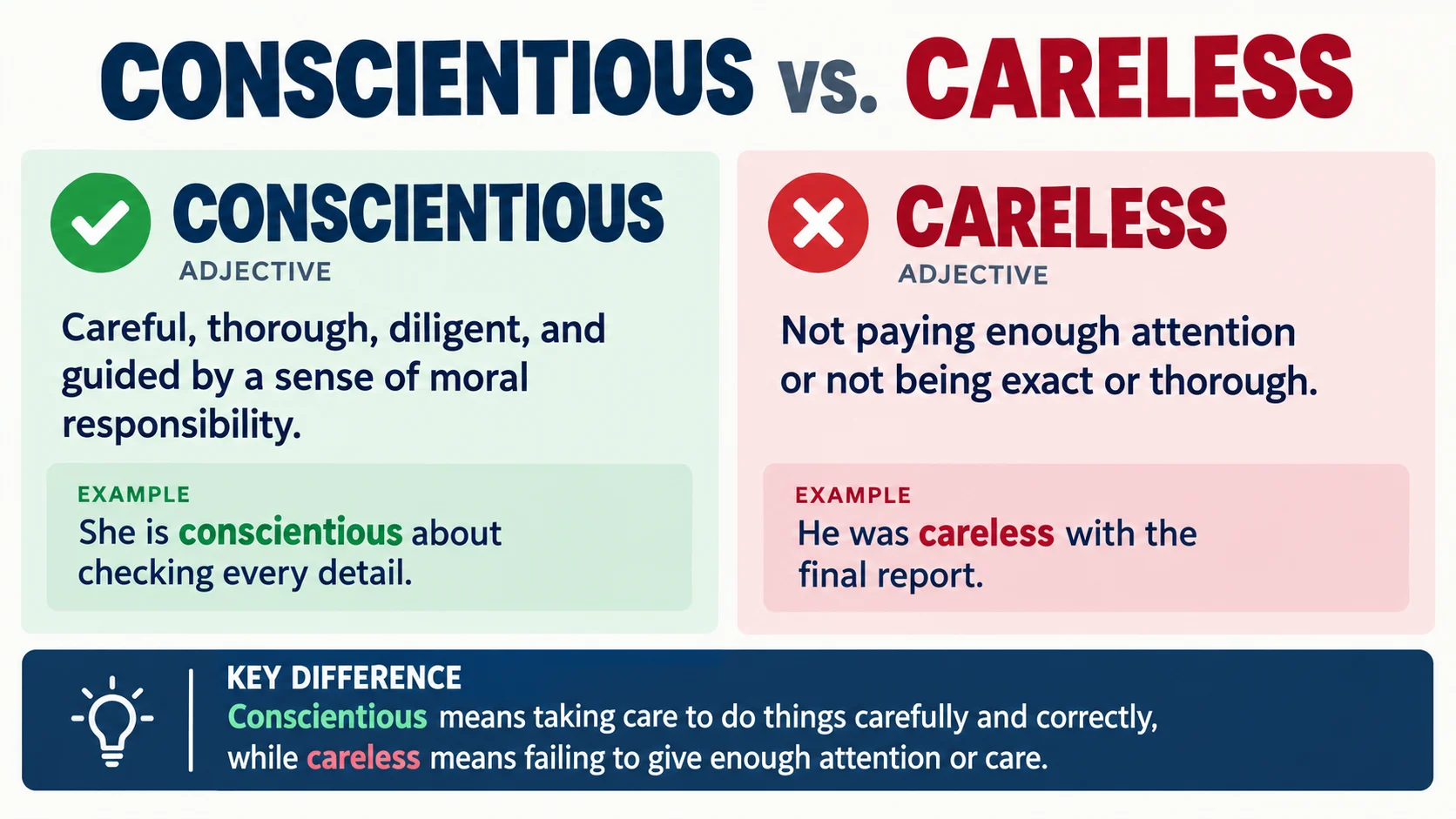
The strongest opposite of conscientious in its common work and behavior sense is careless. Conscientious means careful, thorough, and guided by responsibility, while careless describes someone who does not give enough attention or care. Negligent and irresponsible can also work when the context emphasizes duty or responsibility.
Part of speech: Adjective
Primary opposite: careless
Conscientious describes someone who takes care to do things carefully and correctly, often with a strong sense of responsibility. It can also describe someone who puts substantial effort into work.
When conscientious means careful, thorough, and attentive in carrying out a task, careless is the strongest direct opposite. For example, a conscientious employee checks important details, while a careless employee may overlook them. Cambridge’s thesaurus also lists careless, neglectful, negligent, remiss, irresponsible, and related terms among the antonyms of conscientious.
Direct and Strong Antonyms
| Antonym | Tone or Nuance | Example Sentence |
|---|---|---|
| Careless | Common, direct, and broadly applicable | She was careless with the figures in the final report. |
| Negligent | Formal and stronger, especially when a duty is not properly performed | The manager was negligent in reviewing the safety records. |
| Neglectful | Emphasizes failure to give proper care or attention | He was neglectful of routine maintenance. |
| Irresponsible | Emphasizes failure to act responsibly or fulfill obligations | It would be irresponsible to ignore the warning signs. |
| Remiss | Formal and often used for failure to perform a duty | I would be remiss if I failed to mention the missing documentation. |
| Unreliable | Focuses on dependability rather than carefulness itself | An unreliable coworker may repeatedly miss important deadlines. |
These words are not interchangeable in every sentence. Careless is the broadest everyday opposite for the work-related sense of conscientious. Negligent, remiss, and irresponsible become more precise when the issue involves a duty, obligation, or expected standard of conduct.
Contextual and Subtle Opposites
The best opposite depends on which aspect of conscientious the sentence emphasizes. The word has both a careful-work sense and a moral-responsibility sense. American English dictionaries describe it as involving care, precision, thoroughness, and acting according to conscience.
| Context | Best Opposite | Why It Fits |
|---|---|---|
| Careful work | Careless | It directly contrasts with failing to give sufficient attention or precision. |
| Failure to perform a duty | Negligent | It highlights a serious failure to provide required care or attention. |
| Failure to fulfill responsibilities | Irresponsible | It focuses on poor judgment or failure to act responsibly. |
| Failure to maintain something | Neglectful | It emphasizes inadequate care over time. |
| Formal criticism of an omitted duty | Remiss | It describes being at fault for failing to do something expected. |
Consider the difference between these examples:
Conscientious: “Maria is conscientious about checking every detail before submitting a proposal.”
Careless: “Maria was careless and submitted the proposal without checking the figures.”
Here, careless is the natural opposite because the contrast is about attention and accuracy.
In a more serious professional context, negligent may be more appropriate: “The contractor was negligent in maintaining the required safety records.” The word suggests failure to meet a duty, so it carries a more formal and potentially more serious tone.
Words That Seem Opposite But Are Not
Unfocused can contrast with conscientious behavior, but it is not an exact antonym. Someone can be unfocused temporarily while still being responsible and careful overall. The word describes concentration, not necessarily conscientiousness.
Lazy is another common near-opposite, but it is not a precise antonym. A person can be conscientious without working quickly, and someone who is energetic can still be careless. Lazy emphasizes unwillingness to exert effort, whereas conscientious includes carefulness, responsibility, and attention to doing things correctly.
These distinctions matter when choosing a word for professional or academic writing. Calling someone careless focuses on attention to detail. Calling someone negligent suggests a failure to meet a duty. Calling someone lazy focuses more on effort or willingness to work.
Common Grammatical or Semantic Confusions
A frequent confusion is between conscientious and conscious. They are not opposites. Conscious generally relates to awareness or being awake, while conscientious describes careful, responsible conduct.
Another confusion is between conscientious and conscience. Conscience is a noun referring to a person’s sense of right and wrong. Conscientious is an adjective describing behavior or a person guided by carefulness and responsibility.
Subtle Tone Differences
Choose careless for ordinary, direct criticism: “He was careless with the receipts.”
Choose negligent when the context involves a responsibility or professional duty: “The supervisor was negligent in documenting the incident.”
Choose irresponsible when the main issue is poor responsibility or judgment: “It was irresponsible to leave the equipment unsecured.”
Choose remiss when you want a more formal expression, particularly in professional writing: “We would be remiss not to review the agreement.”
These choices can make a sentence more precise without changing its basic contrast with conscientious.
Frequently Asked Questions
What is the direct antonym of conscientious?
The most direct everyday antonym of conscientious is careless, especially when conscientious means careful, thorough, and attentive in work or behavior. Other antonyms, such as negligent or irresponsible, fit more specific contexts involving duties or responsibility.
What is the opposite of conscientious in the workplace?
In workplace writing, careless is usually the clearest opposite when the issue is attention to detail or accuracy. Negligent is more formal and stronger when an employee fails to meet an important duty or expected standard of care.
Is irresponsible the same as the opposite of conscientious?
Irresponsible can function as a contextual opposite, but it is not identical to careless. Conscientious includes carefulness and responsibility, while irresponsible specifically emphasizes failure to act responsibly or fulfill obligations. The best choice depends on what the sentence needs to emphasize.
Practical Word Choice
- Identify the intended meaning. If the contrast is about attention and accuracy, choose careless. If it concerns a duty, negligent may be more precise.
- Match tone and strength. Use careless for everyday language and consider negligent, irresponsible, or remiss when the context requires a more specific or formal criticism.
Final Thoughts
The strongest everyday opposite of conscientious is careless because the two words directly contrast careful attention with insufficient attention. Other choices become more useful when the sentence emphasizes neglected duties, responsibility, or formal accountability.
Context determines which antonym sounds most natural. A careful writer should consider not only whether a word contrasts with conscientious, but also what specific behavior the sentence describes.
If you have a sentence using conscientious, which opposite would you choose for that particular context?
